TPU with Moisture-Controlled Flexibility

Title: THERMOPLASTIC POLYURETHANE MATERIALS FOR FORMING MEDICAL DEVICES

Number/Link: WO2017/066381

Applicant/Assignee: Becton Dickinson

Publication Date: 20 april 2017

“Gist”: High hardblock TPU, based on side-chain branched chain extenders, softens in water

Why it is interesting: The invention is related to thermoplastic polyurethanes for medical applications especially for intravenous catheters. These catheters need to have a high stiffness when inserted but need to become flexible once in place to prevent injuries. This is accomplished with TPUs based on MDI, PTMEG and either 2,2-dimethyl-1,3-propanediol (neopentylglycol) or 2-methyl-1,3-propanediol (MPdiol) and having a hardblock content of 50 to 75%. The examples show indeed an increased stiffness at ambient conditions and a larger softening when soaked in saline solution compared to TPU produced with a linear chain extender. It is however not mentioned which linear chain extender was used.

Neopentylglycol

In Situ Reticulated Viscoelastic Foams

Patent Title: VISCOELASTIC AND RETICULATED POLYURETHANE FOAM AND THE PREPARATION THEREOF

 Number/Link: WO2016/198433

Applicant/Assignee: Covestro

Publication date: 15-dec-2016

Gist”: Composition of 3 semi-miscible polyols and a surfactant

Why it is interesting: This case claims a polyol composition for the preparation of a viscoelastic, reticulated foam without the need for a separate reticulation step. The composition consists of (at least) three polyols and a surfactant:  a low mole-weight all-PO ‘rigid’ triol, a conventional flexible polyol, a high- or all-EO polyol and some off-the-shelf silicone surfactant.  The composition is foamed with water and polymeric MDI or a polymeric MDI/TDI mixture. This is a well-known composition and it is hard to see why this should result in a reticulated foam – unless maybe in some fine-tuned cases.  Apart from the ball rebound being less than 15% the claims do not mention any parameters related to reticulated foam (such as airflow). It is doubtful (in my opinion) that this will get granted.

Cell structure of a reticulated foam

Cell structure of a reticulated foam

Classic PU Patent of the Month: Microencapsulation (1963)

Patent Title: ENCAPSULATION BY INTERFACIAL POLYCONDENSATION

 Number/Link:  US3577515

Applicant/Assignee: Pennwalt Corp.

Publication date: 4-05-1971

Gist”: Interfacial polycondensation on the surface of emulsified droplets.

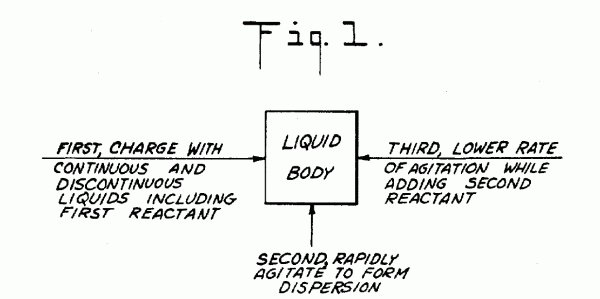
Why it is interesting: Micro-sized droplets are encapsulated with a polymeric film or ‘skin’ formed by an interfacial polycondensation reaction. The idea is both very clever and simple: one reaction component is dissolved in a liquid which is then dispersed in another -immiscible- liquid. The second reaction component is then added to the continuous phase resulting in a polycondensation reaction at the surface of the droplets, encapsulating these with a polymeric film. For example a solution of a polyisocyanates in an organic solvent can be dispersed in water (to a desired droplet size) after which a water soluble diol or diamine is added resulting in a polyurethane or polyurea film encapsulating the solvent droplets. Microcapsules are now common and used in may applications like cosmetics, phase change materials, e-paper, self-healing coatings etc.

Figure 1 illustrating the process

Figure illustrating the process

  • Pages

  • Categories

  • Enter your email address to follow this blog and receive notifications of new posts by email.

    Join 259 other subscribers
  • Follow Innovation in PU on Twitter