Polyols from Epoxies and Cardanol

Title: CARDANOL MODIFIED EPOXY POLYOL

 Number/Link: WO2015/077944  WO2015/077945 WO2015/078178

Applicant/Assignee: Dow

Publication date: 4-06-2015

Gist”: Polyols are prepared by reacting an epoxy resin with  cashew nutshell liquid.

Why it is interesting: Cardanol is the main component of  cashew nutshell liquid which is a by-product of cashew nut processing. It is a “surfactant-like” phenolic compound which, when reacted with a polyepoxide, will result in a polyol with sec-OH groups. When used in polyurethane formulations these polyols will (unsurprisingly) be slow-reacting, highly hydrophobic and show compatibilizing properties vs apolar compounds. Dow have therefore filed three patent applications on PU systems containing these polyols: one on slowly-reacting PU systems for filament winding, one on highly hydrophobic PU elastomers and one on asphalt-PU compositions.
These are interesting polyols but they could be hard to process in my opinion.

Cardanol is reacted with bisphenol-A diglycidylether resulting in a diol according to the invention
Cardanol is reacted with bisphenol-A diglycidylether resulting in a diol according to the invention

Polyols from Urethane Alcohols

Title: USE OF URETHANE ALCOHOLS FOR PREPARATION OF POLYETHER POLYOLS

 Number/Link: WO2015075057

Applicant/Assignee: Bayer

Publication date: 28-05-2015

Gist”: Urethane alcohols prepared from cyclocarbonates are used as starters for polyether polyols

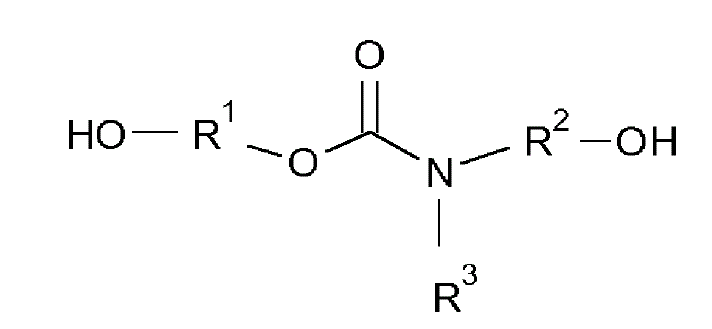
Why it is interesting: Urethane diols are prepared by reacting cyclic carbonates like ethylene- or propylene carbonate with an alkanolamine like e.g. ethanolamine. The alcohols are then further reacted with propylene oxide and/or ethylene oxide to make polyether polyols, useful for the production of flexible foams a.o.  No comparison of the properties of these polyols (or of the resulting foams), with ‘conventional’ polyether polyols, is given. The only advantage (at least for Bayer) being that the polyols are partly based on cyclocarbonates which are by-products of the polycarbonate polyol production.

A Urethane Alcohol

A Urethane Alcohol

Polyurethane Rigid Foam Containing Lignin

Title: COMPOSITIONS OF PHENOLIC BIOPOLYMERS

 Number/Link:WO2015/055662

Applicant/Assignee: Solvay

Publication date: 23-04-2015

Gist”: Lignin is emulsified in a halogenated polyol and then used to prepare rigid foams.

Why it is interesting: This case is about yet another attempt to incorporate lignin into polyurethane materials. In this invention lignin is dispersed in a halogenated polyol using a suitable milling process. The polyol is preferably a brominated ‘rigid’ polyether.  The dispersed lignin (pref.) has a (d90) mean particle size of less than 100μm and is used in an amount of up to about 50% on the brominated polyether.  The lignin dispersion can then be used together with other polyols in rigid foam formulations.  The resulting foams should have improved flammability properties and the lignin is said to have no negative effect on thermal insulation properties.

Part of a typical lignin structure

Part of a typical lignin structure


  • Pages

  • Categories

  • Enter your email address to follow this blog and receive notifications of new posts by email.

    Join 259 other subscribers
  • Follow Innovation in PU on Twitter