Modified Polyisocyanurates

Patent Title: MODIFIED POLYISOCYANURA TE PLASTIC AND METHOD FOR PRODUCTION THEREOF

 Number/Link: WO2017/182108 WO2017/182109  WO2017/182110  (German)  

Applicant/Assignee:  Covestro

Publication date: 26-october-2017

Gist”: Partially trimerized diisocyanates are modified with monofunctional isocyanate-reactive compounds before complete trimerization

Why it is interesting: This series of applications relates to transparent polyisocyanurate coatings with controlled hydrophilicty, hydrophobicity, high scratch resitance etc. According to the invention trimers of diisocanates are reacted with a sub-stoichiometric amount of monofunctional hydrophobic, hydrophilic or siloxane-containing compounds, and then completely trimerized. In the examples HDI-trimer (prepared by partially trimerzing HDI and removing the rest of the monomer by thin film distillation) is reacted with e.g. methoxyPEG 500, dodecanol, perfluoroheptanol and N-(3-trimethoxyxilylpropyl)foramide and then trimerized using potassium acetate as catalyst.  The materials can e.g. be used as anti-fog coatings on optical lenses or anti-fingerprint coatings on cell phones.
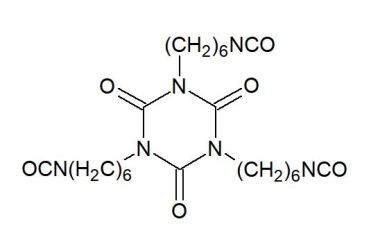
HDI-isocyanurate


TPU Aerosol

Title: POLYURETHANE AEROSOL COMPOSITIONS, ARTICLES, AND RELATED METHODS

Number/Link: US20170198150

Applicant/Assignee: 3M

Publication Date: 13-july-2017  (priority PCT)

“Gist”: Aqueous dispersion of a hydrazide-extended  TPU can be sprayed as aerosol to make protective films

Why it is interesting: An aqueous thermoplastic polyurethane dispersion is prepared from a non-yellowing diisocyanate, e.g. bis(4-isocyanatocyclohexyl), a diol (e.g. PPG2000), a difunctional hydrazine or hydrazide chain extender (e.g. 1,3-diaminourea) and a water solubilizing compound (e.g. dimethylolpropionic acid).  Together with a propellant the, composition is shelf-stable and can be aerosol-sprayed to form clear, non-yellowing protective films.

3M’s aerosol-sprayed protective film.

Self-Healing Polyurethane Elastomers

Patent Title: POLYURETHANE

 Number/Link: W02016185172

Applicant/Assignee: Croda

Publication date: 24-11-2016

Gist”: PU from polyols which contain both a fatty dimer residue and an H-bonding group, show self-healing properties

Why it is interesting: Polyurethane elastomers with ‘intrinsic’ self-healing properties (i.e. without the need for external chemicals like encapsulated monomers) can be prepared by reacting isocyanates with polyols that have at least one urethane, amide or carbonate group and at least one fatty dimer residue. It is theorized that the fatty dimer allows the soft-phase of the polymer to flow and H-bonds to form, thus restoring most of the properties after damage.  In the examples polyols with internal urethane groups were prepared by reacting C36 dimer diol with HDI, which were then reacted with MDI and BDO. Samples of the resulting elastomers were cut in half, and manually stuck together again under mild heating (60°C), thus recovering most of their tensile and elongation properties.

A dimer diol

A dimer diol

  • Pages

  • Categories

  • Enter your email address to follow this blog and receive notifications of new posts by email.

    Join 259 other subscribers
  • Follow Innovation in PU on Twitter