Infrared Curable 2K PU Adhesives

Patent Title: LATENT TWO-PART POLYURETHANE ADHESIVES CURABLE WITH INFRARED RADIATION

 Number/Link: WO2016/205251 and related cases: WO..5252, WO…5254 and WO..5255

Applicant/Assignee: Dow

Publication date: all published on 22 dec 2016

Gist”: Two-component PU adhesive using 3 different delayed-action catalysts

Why it is interesting: Two component adhesive systems need a sufficiently long ‘open time’ preferably combined with a fast cure once activated, e.g. by heat. Heat curing using infrared radiation allows for ‘spot curing’ , i.e. curing only predetermined parts of the adhesive such that the assembly can be handled and can be cured completely in a subsequent step.  This process is fast and saves energy.  The current invention is about IR curable adhesives containing 3 different types of latent catalysts: a latent room temperature organometallic catalyst based on Sn, Zn or Bi added to the polyol component, a phenol-blocked cyclic amidine and a carboxylic acid blocked cyclic amidine.  The two latter catalysts can either be included in the polyol or in the isocyanate component. The catalysts used in the examples are dioctyltinthioglycolate, phenol blocked 1,8-diazabicycloundec-7-ene and a carboxilic acid blocked 1,8-diazabicycloundec-7-ene.

1,8-diazabicycloundec-7-ene

1,8-diazabicycloundec-7-ene

In Situ Reticulated Viscoelastic Foams

Patent Title: VISCOELASTIC AND RETICULATED POLYURETHANE FOAM AND THE PREPARATION THEREOF

 Number/Link: WO2016/198433

Applicant/Assignee: Covestro

Publication date: 15-dec-2016

Gist”: Composition of 3 semi-miscible polyols and a surfactant

Why it is interesting: This case claims a polyol composition for the preparation of a viscoelastic, reticulated foam without the need for a separate reticulation step. The composition consists of (at least) three polyols and a surfactant:  a low mole-weight all-PO ‘rigid’ triol, a conventional flexible polyol, a high- or all-EO polyol and some off-the-shelf silicone surfactant.  The composition is foamed with water and polymeric MDI or a polymeric MDI/TDI mixture. This is a well-known composition and it is hard to see why this should result in a reticulated foam – unless maybe in some fine-tuned cases.  Apart from the ball rebound being less than 15% the claims do not mention any parameters related to reticulated foam (such as airflow). It is doubtful (in my opinion) that this will get granted.

Cell structure of a reticulated foam

Cell structure of a reticulated foam

TPU/PU-Acrylate Semi-IPNs

Patent Title: THERMALLY STABLE MICROSTRUCTURED SEMI-IPN LAYER

 Number/Link: WO2016/191118

Applicant/Assignee: 3M

Publication date: 1-dec-2016

Gist”:  TPU and PU-acrylate oligomers are blended and radiation-cured

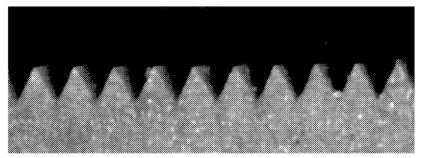
Why it is interesting: According to this invention semi-interpenetrating polymer networks (IPNs) that are prepared from thermoplastic polyurethane (or urethane/urea) and acrylate-functional polyurethane oligomers are highly heat-stable and abrasion resistant and can be used for the production of microstructured surfaces.  Microstructured (‘riblet’) surfaces with dimples or ridges of a few to a few hundred microns deep are used as drag reducing coatings on planes, ships and in aeronautics. In the examples 90% of a commercial TPU is blended and co-extruded with 10% of a commercial aliphatic urethane acrylate oligomer.  The extruded film was then laminated on on a microreplicated liner, radiation cured and removed from the liner to produce the riblet surface.

Microstructured layer according to the invention

Microstructured layer according to the invention

  • Pages

  • Categories

  • Enter your email address to follow this blog and receive notifications of new posts by email.

    Join 259 other subscribers
  • Follow Innovation in PU on Twitter