Self-Healing Polyurethane Elastomers

Patent Title: POLYURETHANE

 Number/Link: W02016185172

Applicant/Assignee: Croda

Publication date: 24-11-2016

Gist”: PU from polyols which contain both a fatty dimer residue and an H-bonding group, show self-healing properties

Why it is interesting: Polyurethane elastomers with ‘intrinsic’ self-healing properties (i.e. without the need for external chemicals like encapsulated monomers) can be prepared by reacting isocyanates with polyols that have at least one urethane, amide or carbonate group and at least one fatty dimer residue. It is theorized that the fatty dimer allows the soft-phase of the polymer to flow and H-bonds to form, thus restoring most of the properties after damage.  In the examples polyols with internal urethane groups were prepared by reacting C36 dimer diol with HDI, which were then reacted with MDI and BDO. Samples of the resulting elastomers were cut in half, and manually stuck together again under mild heating (60°C), thus recovering most of their tensile and elongation properties.

A dimer diol
A dimer diol

Polyurethane for Filament Winding

Patent Title: FILAMENT WINDING PROCESSES USING POLYURETHANE RESINS AND SYSTEMS FOR MAKING COMPOSITES

 Number/Link: W2016183073

Applicant/Assignee: Covestro

Publication date: 17-11-2016

Gist”: Compositions comprising polymeric MDI, amine-initated polyethers and natural oil polyols are useful for filament winding

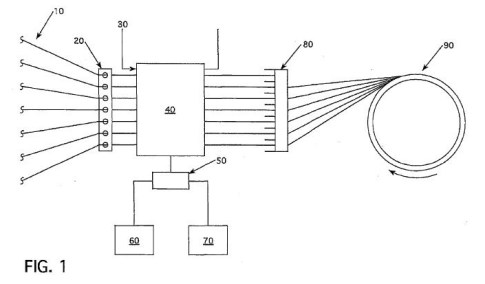
Why it is interesting: Filament winding is a process for the production of hollow composite structures whereby resin-impregnated fibers are wound on a mandrel and then cured. Typically the fibers are impregnated with polyesters or epoxies.  Polyurethane compositions are difficult to use in this process because of reactivity and moisture sensitivity. According to this invention an isocyanate reactive composition comprising at least 50% high functionality amine-initiated polyether polyols and up to 50% of a hydrophobic OH-functional vegetable oil, can be advantageously used for PU filament winding. In the examples blends of 3 and 4-functional amine-initated polyether polyols with mole weight of about 250, castor oil, or OH-functional soy-oil, are used together with a high 2,4′ polymeric MDI.

Filanent winding process

Filanent winding process

Polyrotaxanes in Flexible Foams

Patent Title: POLYOL COMPOSITION FOR PRODUCING FLEXIBLE POLYURETHANE FOAM..

 Number/Link: US20160304689

Applicant/Assignee: Toyo Tire & Rubber

Publication date: 20-10-2016

Gist”: Polyrotaxanes in PU foam reduces ‘wobble’ when used in car seats

Why it is interesting: The use of polyrotaxanes in polyurethanes is not new and has been discussed before in this blog.  According to the current invention polyrotaxanes with OH-functional rings can be incorporated in flexible foams, where they are said to reduce tensile stress while having little impact on compressive properties. When these foams are used in (e.g.) vehicle seats that are subject to low frequency sideways vibrations, they should reduce the sense of “wobble” of the occupants. The theory is that under tension the rings slide along the axis molecule equalizing stresses. In the examples polyrotaxanes with 11000 to 20000 molecular weight PEG axis molecules are used with cyclodextrin rings having an OHv of 43 to 85.

Polyrotaxane-crosllinked polyurethane under stress (schematic)

Polyrotaxane-crosslinked polyurethane under stress (schematic)

  • Pages

  • Categories

  • Enter your email address to follow this blog and receive notifications of new posts by email.

    Join 259 other subscribers
  • Follow Innovation in PU on Twitter