A New Type of Polyurethane Memory Foam

Title: VISCOELASTIC POLYURETHANE FOAM

 Number/Link:WO 2014/058857

Applicant/Assignee: BASF

Publication date: 17-04-2014

Gist”: Using TDI, two high MW and high EO polyether triols, hydrolizable PDMS and DELA results in a flexible foam with a low Tg ánd a low resilience.

Why it is interesting: While viscoelastic or “memory” foams are popular in the furniture industry they are currently not used in e.g. car seats because of their limited use temperature. Typically these foams become too stiff at lowish temperatures and often too soft and resilient at higher temperatures. The current invention is about viscoelastic foams which are useful for transport applications because they show constant properties over a wide temperature range. This is accomplished by reacting TDI with a (about) 4000 MW,  75% EO triol, an EO-capped 6500 MW, 75% EO triol, quite some diethanolamine (DELA), and quite some (2.5 pdw in the examples)  hydrolyzable polydimethylsiloxane copolymer (PDMS), together with water and catalysts. The foams show two Tg’s one at about -20°C and a minor one at about -55°C (probably due to a seperate PDMS phase) which keeps the foams resilient at low temperatures. The -20°C polyether phase is probably mixed with the DELA-TDI phase resulting in a wide transition reaching to over 0°C. This results in a resilience of  about 30% which is quite high for a typical ‘memory’ foam.

Polyurethane "memory foam"

Polyurethane “memory foam”

Highly Stable Isocyanate Dispersions

Title: STORAGE-STABLE HYDROPHILIC POLYISOCYANATES

 Number/Link: WO2014/053269   (German)

Applicant/Assignee: Evonik

Publication date: 10-04-2014

Gist”: A uretdion-containing isocyanate prepolymer is reacted with a neutralized aminealkylsulfonic acid to produce a novel hydrophilic (latent) isocyanate which can be used in stable aqueous dispersions.

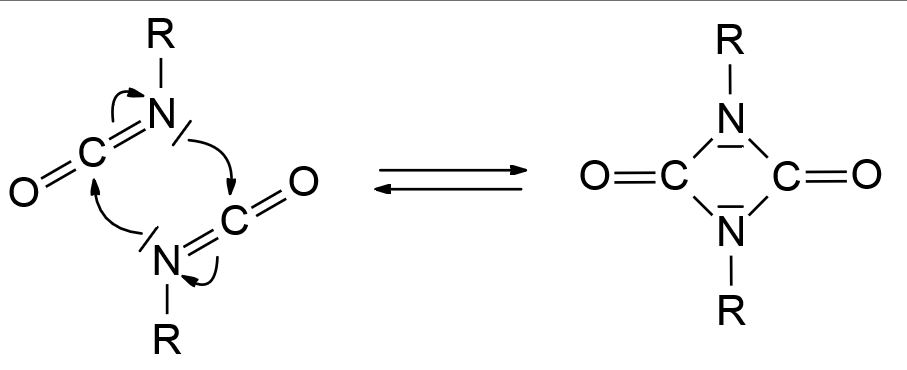
Why it is interesting: Aqueous dispersions of isocyanates are useful in many applications as adhesives, binders, crosslinkers etc, but usually suffer from a relatively short shelf life.  Dispersions prepared according to the current invention supposedly lose less than 30% of their initial NCO value after 12 weeks storage at 50°C. In an example an aceton-solution of  an IPDI-uretdion prepolymer with an isocyanate content of 1.5% is reacted with the sodium salt of an aminealkylsulfonate in water to an NCO value of 0.1%. After removal of the aceton the resulting dispersion had a latent isocyanate content of 4.5%

Dimerization of isocyanate to uretdion.

Reversible dimerization of isocyanate to uretdion.

Crosslinking TPU with Isocyanates.

Title: POLYURETHANE ON THE BASIS OF SOFT THERMOPLASTIC POLYURETHANE

 Number/Link: US2014/0094571

Applicant/Assignee: BASF

Publication date: 3-04-2014 (priority PCT/DE)

Gist”: A soft TPU is crosslinked using isocyanate dissolved in another TPU.

Why it is interesting: Crosslinking thermoplastic polyurethane parts to improve certain mechanical- and creep properties is known. In this case the crosslinking agent is an isocyanate with a functionality larger than 2, preferably an MDI prepolymer.  The isocyanate is dissolved in another TPU by melt blending in a twin-screw extruder at a temperature below 160°C and pelletizing. Pellets of a soft, polyester-based, TPU with a hardblock content less than 5% are mixed with the isocyanate-containing pellets, injection moulded and post-cured to crosslink the moulded part.

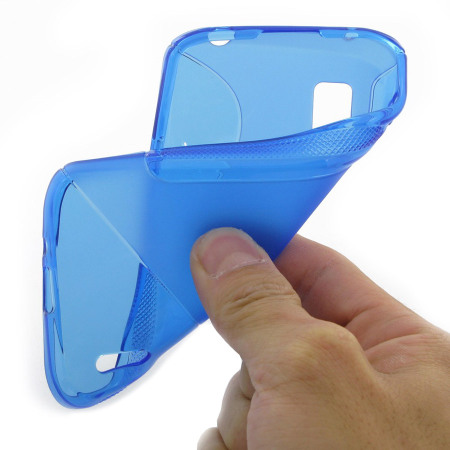
A TPU phone case.

TPU phone case.

  • Pages

  • Categories

  • Enter your email address to follow this blog and receive notifications of new posts by email.

    Join 259 other subscribers