Flexible Foams with Improved Thermal Comfort

Title: IN-SITU GELATINOUS TRIBLOCK COPOLYMER ELASTOMERS IN POLYURETHANE FLEXIBLE FOAMS

 Number/Link:US2015/0166756

Applicant/Assignee: Peterson Chemical Technology

Publication date: 18-06-2015

Gist”: Gelatinous styrenic block copolymers are incorporated in flexible foams to increase thermal conductivity.

Why it is interesting: High viscosity styrenic triblock copolymer resins (like SBS, SEBS, SIS etc), plasticized with mineral oils, are added to flexible foam-forming compositions. The heat of the foam-forming reaction is said to be sufficient to further polymerize the resins and melt the styrene-block such that the block copolymers get integrated into the polyurethane matrix. The resulting foams show increased load bearing and improved thermal conductivity. These systems could improve the thermal comfort properties of cushioning materials, especially those of viscoelastic foams.

Poly(styrene-butadiene-styrene) or SBS.

Poly(styrene-butadiene-styrene) or SBS.

Hydrophobic Thermoplastic Polyurethanes

Title: POLYURETHANE

 Number/Link: US2015/0119535

Applicant/Assignee: Nippon Soda

Publication date: 30-04-2015 (priority PCT/JP)

Gist”: TPU based on a ‘hybrid’ polybutadiene-polyester polyol and an asymmetric isocyanate

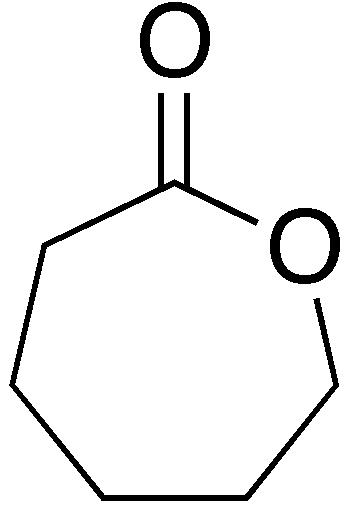
Why it is interesting: According to this invention, TPUs with excellent water-resistance can be prepared from a polyol which is made by reacting a polybutadiene diol with a mole weight of a few 1000 with a cyclic ester monomer, up to a mole weight of about 5000 to 15000 (preferred).  The resulting ‘hybdrid’  (polyester-polybutadiene-polyester) polyol is then prepolymerized with a surplus of an assymetric di-isocyanate. Finally the prepolymer is reacted with a chain extender to make the TPU. In the examples polybutadiene diols are reacted with ε-caprolactone and then with IPDI or 2,4-TDI.  The chain extender used is 1,4-butanediol. Interesting materials and (but) relatively soft as would be expected.

Caprolactone

Caprolactone

Particle-Reinforced Thermoplastic Polyurethane

Title: COMPOSITION AND ARTICLE COMPRISING THERMOPLASTIC POLYURETHANE AND PARTICULATE ENGINEERING POLYMER

 Number/Link: WO2015/031292

Applicant/Assignee: SABIC

Publication date: 5-03-2015

Gist”: TPU is reinforced with ultrafine particles made from engineering thermoplastics having a melting point of over 200°C.

Why it is interesting: Particulate polyarylsulfone, polyimide, poly(phenylene sulfide) or polyamide, with a melting point or glass transition higher than 200°C and average particle size between 5 and 200 μm, is melt-blended with TPU at a temperature below 200°C and in an amount of 10-30% (w/w).  Alternatively the particles could be mixed (“slurried”) with the polyol and/or isocyanate used to produce the TPU.  The resulting composite is said to have increased hardness, tensile strength and heat resistance.
Sabic is becoming quite active in polyurethane innovation and is apparently looking for synergies with its engineering thermoplastics business.

Poly (1,4-phenylene sulfide) (PPS)

Poly (1,4-phenylene sulfide) (PPS)

  • Pages

  • Categories

  • Enter your email address to follow this blog and receive notifications of new posts by email.

    Join 259 other subscribers
  • Follow Innovation in PU on Twitter