Polyurethane-Polyamides from Dimer Diacids

Title: A POLYOL BASED ON DIMER FATTY ACID RESIDUES AND THE CORRESPONDING POLYURETHANES

 Number/Link:WO2015/097433

Applicant/Assignee: Croda

Publication date: 2-07-2015

Gist”: Polyurethane/polyamide elastomers based on dimer diacids and long chain dicarboxylic acids

Why it is interesting: Polyurethane elastomers (and thermoplastic elastomers) based on dimer diacids or dimer diols are very hydrophobic and hydrolysis resistant but are relatively soft with lowish mechanical properties. According to this invention, using a blend of a dimer diacid (or -diol) and a (semi-) crystalline C17 to C32 dicarboxilic acid (or -diol) results in elastomers with greatly improved hardness and tensile strength while retaining flexibility and hydrolysis resistance. The C17 to C32 dicarboxylic acids can be prepared by a self-metathesis reaction of unsaturated fatty acid esters.  In the examples a C36 dimer diacid is used together with 1,18-octadodecanoic acid (prepared by metathesis from methyl oleate).  This is reacted ‘one shot’ with 4,4′ MDI and hexanediol or DEG, resulting in 85 shore A elastomers with high elongation and hydrolysis resistance.
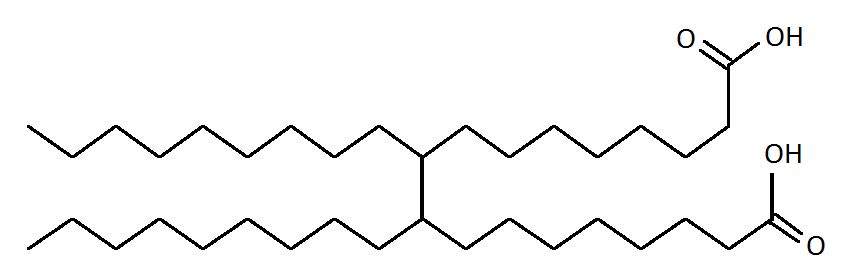
A C36 dimer diacid

A C36 dimer diacid

Polyols from Epoxies and Cardanol

Title: CARDANOL MODIFIED EPOXY POLYOL

 Number/Link: WO2015/077944  WO2015/077945 WO2015/078178

Applicant/Assignee: Dow

Publication date: 4-06-2015

Gist”: Polyols are prepared by reacting an epoxy resin with  cashew nutshell liquid.

Why it is interesting: Cardanol is the main component of  cashew nutshell liquid which is a by-product of cashew nut processing. It is a “surfactant-like” phenolic compound which, when reacted with a polyepoxide, will result in a polyol with sec-OH groups. When used in polyurethane formulations these polyols will (unsurprisingly) be slow-reacting, highly hydrophobic and show compatibilizing properties vs apolar compounds. Dow have therefore filed three patent applications on PU systems containing these polyols: one on slowly-reacting PU systems for filament winding, one on highly hydrophobic PU elastomers and one on asphalt-PU compositions.
These are interesting polyols but they could be hard to process in my opinion.

Cardanol is reacted with bisphenol-A diglycidylether resulting in a diol according to the invention

Cardanol is reacted with bisphenol-A diglycidylether resulting in a diol according to the invention

Polyols from Urethane Alcohols

Title: USE OF URETHANE ALCOHOLS FOR PREPARATION OF POLYETHER POLYOLS

 Number/Link: WO2015075057

Applicant/Assignee: Bayer

Publication date: 28-05-2015

Gist”: Urethane alcohols prepared from cyclocarbonates are used as starters for polyether polyols

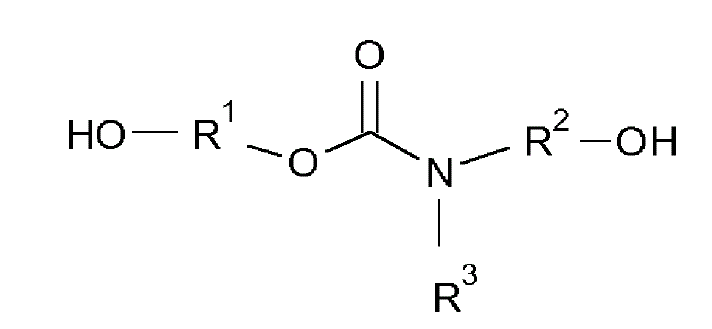
Why it is interesting: Urethane diols are prepared by reacting cyclic carbonates like ethylene- or propylene carbonate with an alkanolamine like e.g. ethanolamine. The alcohols are then further reacted with propylene oxide and/or ethylene oxide to make polyether polyols, useful for the production of flexible foams a.o.  No comparison of the properties of these polyols (or of the resulting foams), with ‘conventional’ polyether polyols, is given. The only advantage (at least for Bayer) being that the polyols are partly based on cyclocarbonates which are by-products of the polycarbonate polyol production.

A Urethane Alcohol

A Urethane Alcohol

  • Pages

  • Categories

  • Enter your email address to follow this blog and receive notifications of new posts by email.

    Join 259 other subscribers
  • Follow Innovation in PU on Twitter