1K Dual Cure Polyurethane Adhesive

Patent Title: DUAL CURE 1K PU ADHESIVE FORMULATIONS USING MATRIX ENCAPSULATED POLYAMINES

 Number/Link: W02016022346

Applicant/Assignee: Dow

Publication date: 11-02-2016

Gist”: Encapsulated polyamines are added to a moisture curing adhesive

Why it is interesting: One component (1K) PU adhesives are either NCO-ended prepolymers cured by atmospheric moisture, or OH-ended prepolymers containing encapuslated or blocked isocyanates and which are cured by heat.  According to this invention a 1K adhesive curable by both moisture and heat can be made by incorporating an encapuslated polyamine into a 1K mositure curing prepolymer. The amine is solid at room temperature (e.g. 1,12-dodecanediamine) and is mixed with a (semi-)crystalline termoplastic with a well defined melting point, e.g. a polyacrylate or polyolefine before being added to the adhesive. Dual cure 1K adhesives allow for heat-curing the adhesive at critical spots to providing stability to an assembly.  The adhesives are said to be especially useful for the automotive industry.

1,12-dodecanediamine

1,12-dodecanediamine


PUDs for Superhydrophobic Coatings

Patent Title: Vegetable Oil-Modified, Hydrophobic Polyurethane Dispersions

 Number/Link: US20160009852

Applicant/Assignee: Rust-Oleum

Publication date: 14-01-2016

Gist”: PUDs containing saturated monoglycerids

Why it is interesting: Aqueous polyurethane dispersions are popular for use in environmentally friendly coating compositions. Because of the inherent presence of hydrophilic (often acid-) groups to stabilise these dispersions, the resulting coatings often lack hydrolytic stability. According to this invention, this can be improved by incorporating monoglycerids, prepared by reacting vegetable oils with glycerol followed by distillation, into the PU backbone.  A prepolymer is prepared by reacting the monoglicerids, together with a non-isocyanate urethane polyol (prepared from polyamines and monocyclic carbonates), a conventional long-chain polyol and dimethylolpropionic acid, with an excess of isocyanate. The prepolymer is then neutralized with an amine and subsequently reacted with a chain extender in water to make the PUD. Coatings made with these dispersions are said to be superhydrophobic and have a low friction coeficient.

Dimethylolpropionic acid

Dimethylolpropionic acid

TPU from Asymmetric Chain Extenders

Patent Title: THERMOPLASTIC POLYURETHANE

 Number/Link: WO2015/173337

Applicant/Assignee: Henkel

Publication date: 19-11-2015

Gist”: TPU is made using diols with 1 prim- and one sec-OH group

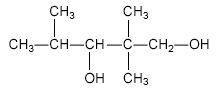
Why it is interesting: Thermoplastic polyurethanes (TPU) have many desirable properties but are notoriously difficult to process: they need a high processing temperature (>160°C ) and have a high melt viscosity requiring high shear processing equipment. According to the current invention the melt viscosity can be greatly reduced by using an asymmetric diol as chain extender (i.e. with one pimary and one secondary hydroxyl group) instead of a conventional symmetric diol. In the examples polyester-MDI TPUs extended with asymmetric diols (e.g. 1,3-butanediol or 2,2,4-trimethyl-1,3-pentanediol)  are shown to have a much lower melt viscosity compared to TPU extended with 1,4-butanediol. These TPUs are especially useful as hotmelt adhesives.

2,2,4,-trimethyl-1,3-pentanediol

2,2,4,-trimethyl-1,3-pentanediol

  • Pages

  • Categories

  • Enter your email address to follow this blog and receive notifications of new posts by email.

    Join 259 other subscribers
  • Follow Innovation in PU on Twitter