Novel Polyurethane Gels

Patent Title: POLYURETHANE BASED GEL COMPOSITION

 Number/Link: W016/036786

Applicant/Assignee: Dow

Publication date: 10-03-2016

Gist”: PU gels are made from MDI prepolymer, high EO polyol and some diamine at low NCO index.

Why it is interesting: Polyurethane gels are well known and are sometimes used in comfort cushioning as layers or dispersed as particles in e.g. viscoelastic matresses. According to this invention plasticizer-free gels can be made by reacting a slightly branched, low NCO prepolymer ( based on 2,4′ and 4,4′ MDI and a high EO polyol), with a large amount of high EO polyol (triol or higher) and some amine-ended low mole-weight diol.
Although the material is said to be ‘plasticizer-free’not all of the polyol will be reacted at low NCO index.  However, because of its high polarity, the unreacted polyol will probably not leach.
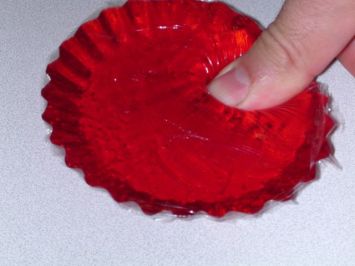
A Polyurethane Gel

A Polyurethane Gel

Spirocyclic Chain Extenders in TPU

Patent Title: THERMOPLASTIC POLYURETHANE WITH HIGH HEAT RESISTANCE

 Number/Link: W02016025421  WO2016025423

Applicant/Assignee: Lubrizol

Publication date: 18-02-2016

Gist”: Use of spirocyclic chain extenders increases heat resistance of TPU

Why it is interesting: Both these patent applications are about the use of alkylene-substituted spirocyclic diols to improve the heat resistance of thermoplastic polyurethanes. In the WO..21 case the diol is used together with MDI and a polycarbonate diol resulting in high heat resistance TPU useful e.g for cable and wire coatings.  In the WO..23 case the spirocyclic diol is used together with MDI and a polyether polyol (PEGs) resulting in TPU with high heat resistance and moisture vapour transmission.  The spirocyclic diol used in the examples is 3,9-bis(1,1-dimethyl-2-hydroxyethyl)-2,4,8,10-tetraoxaspiro[5.5]undecane.

3,9-bis(1,1-dimethyl-2-hydroxyethyl)-2,4,8,10-tetraoxaspiro[5.5]undecane

3,9-bis(1,1-dimethyl-2-hydroxyethyl)-2,4,8,10-tetraoxaspiro[5.5]undecane

Classic PU Patent of the Month: ICI on “High EO – Pure MDI” Flexible Foams (1991)

Patent Title: Polyurethane Foams

 Number/Link: EP0547765

Applicant/Assignee: ICI

Publication date: 23-06-1993

Gist”: Flexible foams can be based on 4,4’MDI if the polyol contains 50 to 85% EO

Why it is interesting: The first flexible PU foams were all based on toluene diisocyanate and so-called “conventional polyols” (i.e. almost all-propylene oxide polyols). Attempts to replace TDI by the only other commercially viable diisocyanate (4,4′ MDI) failed because of premature phase separation of the highly symmetrical polyurea ‘hard block’, resulting in unstable foaming. The problem was eventually solved by using prepolymers and polymeric MDI, as mentioned before.  More than 10 years later it was shown that it is possible to make flexible foams with 4,4′-MDI if the polyol is polar enough to prevent early phase separation.  This was established by using polyols with high ethylene oxide content. The resulting foams have superior comfort and durability properties compared to both TDI and MDI flexible foams.

4,4'-MDI

4,4′-MDI

  • Pages

  • Categories

  • Enter your email address to follow this blog and receive notifications of new posts by email.

    Join 259 other subscribers
  • Follow Innovation in PU on Twitter