Insulating Wood-Aerogel Composites

Title: REINFORCED ORGANIC NATURAL FIBER COMPOSITES

 Number/Link: WO2015/144267

Applicant/Assignee: Huntsman

Publication date: 1-10-2015

Gist”: Aerogel particles are incorporated in composite wood boards

Why it is interesting: Composite wood products (OSB, MDF..) are  well known and popular construction materials which are produced by compressing wood fibers (or flakes and the like) together with a binder like e.g. a polymeric MDI. Typically these materials show thermal conductivity values of about 50 mW/m.K at densities of around 200 kg/m³.  According to this invention these insulation values can be significantly improved by incorporating (a large amount of) hydrophobic nanoporous particles and binding the composite with an in-water emulsified isocyanate. In the examples silica aerogel particles and wood fibers are mixed an bonded with an emulsifiable MDI. The amount of particles ranges from about 25 to 50% (w/w) resulting in composites with densities below 200 kg/m³ and insulation values of about 20 to 30 mW/mK.
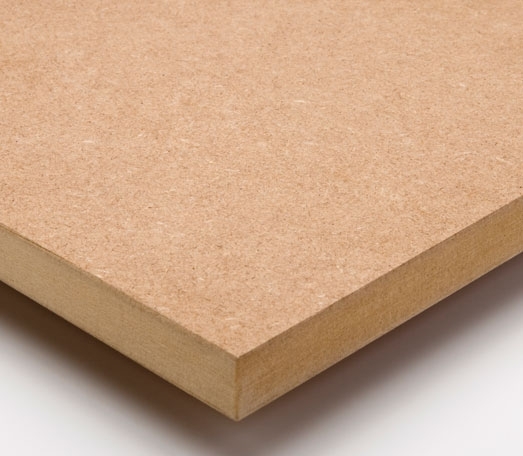
Medium density fibreboard (MDF).
Medium density fibreboard (MDF).

Aerogels from Urethane-Acrylate Star Monomers

Title: FLEXIBLE TO RIGID NANOPOROUS POLYURETHANE-ACRYLATE (PUAC) TYPE MATERIALS FOR STRUCTURAL AND THERMAL INSULATION APPLICATIONS

 Number/Link:US2015/0266983

Applicant/Assignee: University of Missouri

Publication date: 24-09-2015

Gist”: A trifunctional acrylate-ended urethane monomer is polymerized in solvent and supercritically dried

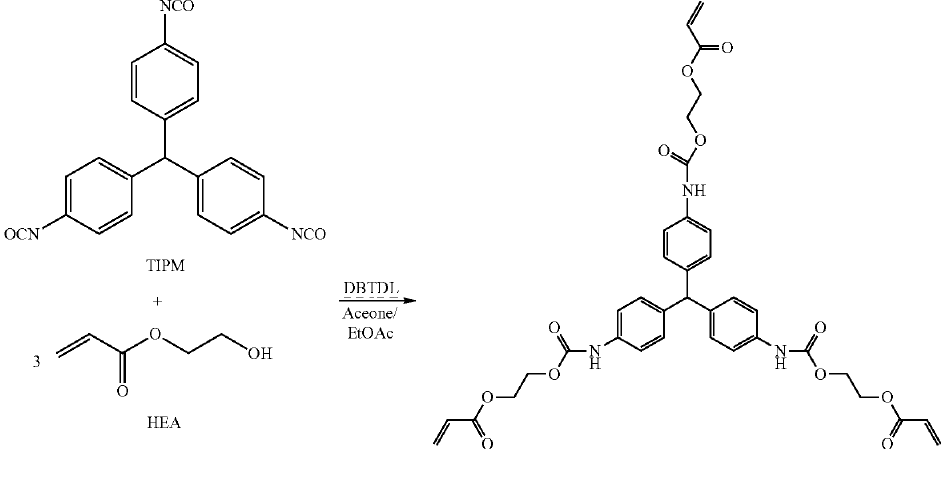
Why it is interesting: Research related to nanoporous materials has been gaining significant momentum in recent years and both inorganic (usually silica-based) and organic (e.g resorcinol-formaldehyde or polyurethane -based) aerogels are increasingly being used especially for thermal insulation applications. The current invention relates to hybrid PU-AC aerogels prepared from acrylate functional “star” monomers. The monomers are made by reacting a tris(isocyanatoaryl)methane with one or more hydroxyacrylates in a suitable solvent.  The monomer is then radically polymerized and the resulting ‘wet’ gel is supercritically dried into an aerogel. In the examples tris(4-isocyanatophenyl)methane is reacted with 2-hydroxyethylacrylate in ethyl acetate. The monomer solution is polymerized by heating with a radical initiator and the resulting gel is then dried using acetone and supercritical CO2.  The resulting aerogels have a density ranging from about 135 to 650 kg/m³ with a porosity bewteen 90 and 50% (v/v).  The lower density aerogels are flexible and have a thermal conductivity of about 40 mW/m.K.

Star monomer according to the invention

Star monomer according to the invention

Classic PU Patent of the Month: Bayer on Viscoelastic Flexible Foams (1988)

Title: Process for the preparation of cold-hardening flexible polyurethane foams having excellent deadening properties.

 Number/Link: EP0331941

Applicant/Assignee: Bayer

Publication date: 13-09-1989

Gist”: Highly damping flexible foams are made using a mixture of three specific polyols.

Why it is interesting: “Visco” or “memory” foams are currently known especially for their use in matresses and pillows.  Originally however these “dead” foams were developed as vibration damping materials for acoustic applications. The invention is based on the use of three specific polyols: (a) a ‘normal’ PO/EO-tipped triol with a hydroxyl value of about 28, (b) a ‘rigid’ all-PO triol with OHv of about 350 and (c) a ‘high EO’ triol with an EO content of about 75% and OHv of 36. The polyols are used in a ratio of about 25:15:60 (a:b:c) together with either TDI or MDI. Because the polyols are relatively immiscible the resulting foams have a soft-phase glass transition which is ‘smeared’ out over a temperature range controlled by polyol (a) at the low end and by (c) at the high end – ranging e.g. from -30°C to +10°C. This wide glass transition in turn results in a very wide damping frequency range.  A very clever idea that has been copied many times.

Polyurethane "memory foam"

Polyurethane “memory foam”

  • Pages

  • Categories

  • Enter your email address to follow this blog and receive notifications of new posts by email.

    Join 259 other subscribers
  • Follow Innovation in PU on Twitter