Water Soluble Polyurethane “Star Polymers”

Title: MULTI-ARM HYDROPHILIC URETHANE POLYMERS, METHODS OF MAKING THEM, AND COMPOSITIONS AND PROCESSES EMPLOYING THEM

 Number/Link: US2014/038874

Applicant/Assignee: Stepan

Publication date: 6-02-2014

Gist”: PU star polymers, useful as surfactants, are prepared from a polyhydroxy ‘core’ molecule, a diisocyanate and a surplus of PEG.

Why it is interesting: A low MW ‘core’ molecule with an OH functionality of up to 6 is reacted with a surplus of diisocyanate to form an NCO ended prepolymer. The prepolymer is then reacted with a suplus of a polyethylene glycol (PEG).  Reactants and ratios are chosen such that the average MW of the resulting product is less than about 10,000 and is water soluble or at least water dispersible. In an example trimethylolpropane is reacted with dicyclohexylmethane di-isocyanate (H12MDI) and ‘capped’ with PEG 400,  resulting in a mixture of structures, one of which is shown below.  The star polymers are supposedly useful as surfactants for use in detergents etc..
While these are interesting molecules, I doubt that these stuctures can be controlled finely enough to compete with established surfactants. I might be more interesting to use methoxy PEGs (i.e. monols) instead of PEGs.
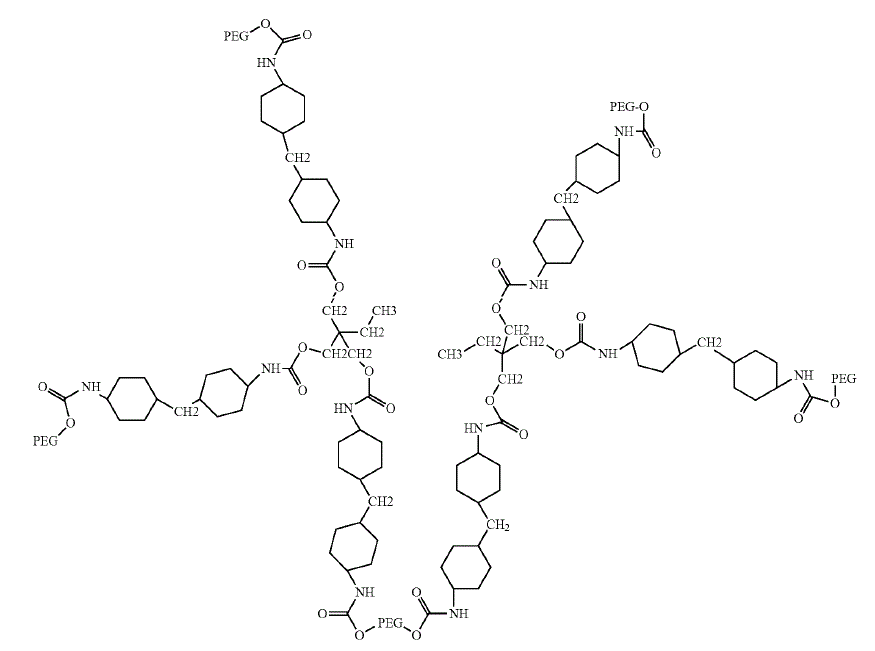
Example of a PU star polymer.
Example of a PU star polymer.

Unique Type of Polyurethane Flexible Foam to Reduce Tyre Noise

Title: TYRE, THE INNER WALL OF WHICH HAS A LAYER OF SPECIFIC POLYURETHANE FOAM

 Number/Link: WO2013/182477 (French)

Applicant/Assignee: Michelin

Publication date: 12-12-2013

Gist”: A layer of flex foam is used to reduce cavity noise in car tyres, the foam being prepared form high EO polyol and 4,4′ MDI.

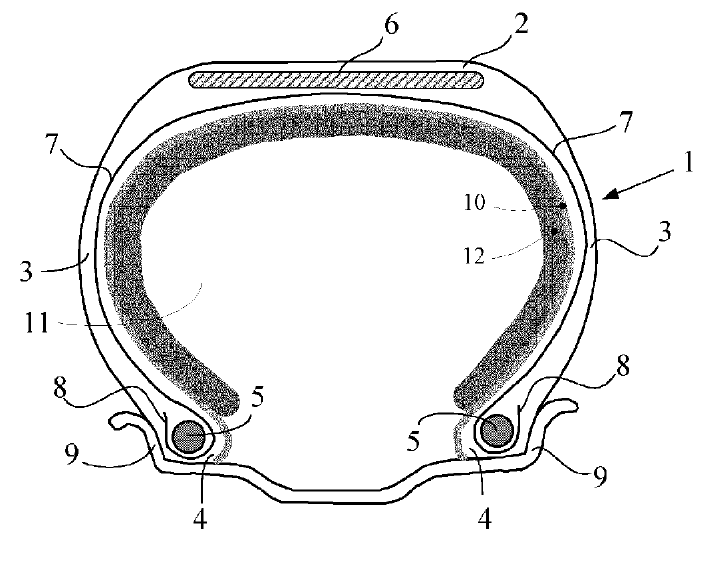
Why it is interesting: An important component of the noise produced by driving vehicules is attributed to resonances in the tyre cavities. It is know that this noise can be reduced by (partly) filling the tyre cavity with PU foam, but the foams are difficult to apply, add too much weight and do not show enough sound absorption. According to this invention these problems can be solved by adhering a layer of a specific flexible foam to the inside of the tire.  The foam has a low density (30 to 60 kg/m³), and absorbs sound at the correct frequency for cavity resonances (190-230Hz).  It is prepared from a prepolymer based on a  70-90% EO polyol and 4.4′ MDI, which is mixed with water and catalyst.  The reacting mixture is poured into a spinning tyre where it cures and adheres to the inside of the cavity.
This foam -inlcuding the prepolymer- was actually invented by myself in 1991: EP547765

Cross-section of foam-lined tire according to the invention.

Cross-section of foam-lined tire according to the invention.

Polyurethane/Polyurea Elastomers from 2,4′-MDI and MDA

Title: MOLDED POLYURETHANE ELASTOMER PARTS MADE OF DIPHENYLMETHANE DIISOCYANATE-BASED NCO PREPOLYMERS AND METAL SALT COMPLEXES, AND A METHOD FOR PRODUCING SAME

 Number/Link: US2013267655

Applicant/Assignee: Bayer

Publication date: 10-10-2013 (priority PCT/DE)

Gist”: Molded PU/PUA elastomers are prepared from a 2,4′-MDI based prepolymer cured with blocked MDA

Why it is interesting: A prepolymer with an NCO content between 3 to 7% is prepared from MDI containing more than 97% of the  2,4′ isomer together with a diol with an OH value of about 100.  (e.g a PTMEG or a polycaprolacton).  The prepolymer is then cured with a salt-complexed diphenylmethanediamine (“blocked MDA”). Because of it’s relatively low viscosity and long potlife the system allows for the production of thick-walled, bubble-free molded elastomers.  Probably because there is less premature polyurea phase separation (due the 2,4′-MDI) the system cures homogeneously.

4,4'-MDA

4,4′-MDA

  • Pages

  • Categories

  • Enter your email address to follow this blog and receive notifications of new posts by email.

    Join 259 other subscribers
  • Follow Innovation in PU on Twitter