A New Type of Ultra-Soft Thermoplastic Polyurethanes

Title: THERMOPLASTIC POLYURETHANES WITH CRYSTALLINE CHAIN ENDS

 Number/Link: WO2014/070426

Applicant/Assignee: Lubrizol

Publication date: 8-05-2014

Gist”: Easily processable, plasticizer-free ultra-soft TPU can be produced by incorporating a crystallizing polyolefin chain stopper.

Why it is interesting: It is well known that TPU with a shore hardness below about 65A is hard to produce and process because of its stickiness and low solidification/crystallization rate. According to the invention this problem can be solved by using a crystalline chain stopper in addition to the polyol, chain extender and di-isocyanate. The chain stopper is (preferably) a c20 to c70 polyolefin mono-alcohol. Apart from improving processability at low hardness, the incoproration of the olefin chain stopper also improves compatibility of the TPU with olefin thermoplastics.  The chain stopper can also be grafted with e.g. a vinyl alkoxysilane to make a hybrid crosslinkable TPU.  An interesting idea with many potential advantages and interesting effects.

Lubrizol logo

Lubrizol logo

A New Type of Polyurethane Memory Foam

Title: VISCOELASTIC POLYURETHANE FOAM

 Number/Link:WO 2014/058857

Applicant/Assignee: BASF

Publication date: 17-04-2014

Gist”: Using TDI, two high MW and high EO polyether triols, hydrolizable PDMS and DELA results in a flexible foam with a low Tg ánd a low resilience.

Why it is interesting: While viscoelastic or “memory” foams are popular in the furniture industry they are currently not used in e.g. car seats because of their limited use temperature. Typically these foams become too stiff at lowish temperatures and often too soft and resilient at higher temperatures. The current invention is about viscoelastic foams which are useful for transport applications because they show constant properties over a wide temperature range. This is accomplished by reacting TDI with a (about) 4000 MW,  75% EO triol, an EO-capped 6500 MW, 75% EO triol, quite some diethanolamine (DELA), and quite some (2.5 pdw in the examples)  hydrolyzable polydimethylsiloxane copolymer (PDMS), together with water and catalysts. The foams show two Tg’s one at about -20°C and a minor one at about -55°C (probably due to a seperate PDMS phase) which keeps the foams resilient at low temperatures. The -20°C polyether phase is probably mixed with the DELA-TDI phase resulting in a wide transition reaching to over 0°C. This results in a resilience of  about 30% which is quite high for a typical ‘memory’ foam.

Polyurethane "memory foam"

Polyurethane “memory foam”

Polyurethane Elastomers with Very Low Glass Transition Temperature

Title: Low temperature segmented copolymer compositions and methods

 Number/Link: US8334356

Applicant/Assignee: Boeing

Publication date: 18-12-2012

Gist”: Polyurethane/polyurea elastomer based on a softblock mixture comprising dihydroxyalkyl terminated polydimethylsiloxane and a hydroxy terminated perfluoroether (or other low Tg softblock like OH terminated polybutadiene, polyphosphazenes etc) together with a rigid diamine chain extender (DETDA type) and a diisocyanate (HMDI in the examples). The softblocks have a molecular weight of 5000 or more and a functionality of 2.

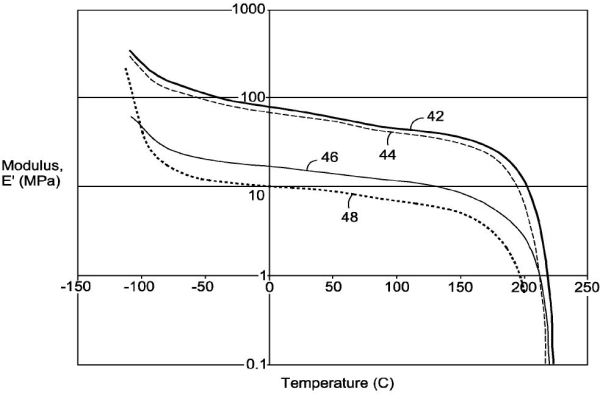
Why it is interesting:  The materials are claimed to have a Tg between -60 and -110°C with still very high elongation and tensile strength values at -100°C. The molecules are linear but will probably not melt because of the high urea content.  They will however be soluble in the correct solvents.

Tgs

Modulus-Temperature graphs of materials according to the invention.

  • Pages

  • Categories

  • Enter your email address to follow this blog and receive notifications of new posts by email.

    Join 259 other subscribers
  • Follow Innovation in PU on Twitter