TPU from HDI and H12MDI

Patent Title: NON-SOFTENING RESILIENT THERMOPLASTIC POLYURETHANES

 Number/Link: WO2016/054320

Applicant/Assignee: Lubrizol

Publication date: 7-04-1016

Gist”: TPU from a blend of HDI and H12MDI has improved creep and wet modulus

Why it is interesting: Polymeric materials used for in vivo medical applications like catheters, need to be hydrolytically stable and retain physical properties like stiffness, resilience, flexibility etc. in wet conditions.  It is known that conventional TPUs based on aromatic or cyclo-aliphatic isocyanates tend to show some softening in aqueous environments. For this reason copolyamides (COPAs) and polyether-block-polyamides (PEBAs) are often preferred over TPU for use in medical devices.  According to this invention, TPUs that can replace COPA and PEBA in medical applications can be produced using a blend of 1,6-hexanediisocyanate (HDA) and H12MDI. In the examples polyether TPUs, prepared from 2000MW polytetramethyleneether diol, butanediol and a 19:1 HDI:H12MDI isocyanate blend at harblock contents ranging from 15 to 50%, convincingly show improved creep properties and wet modulus when compared to conventional TPU and a commercial PEBA material.
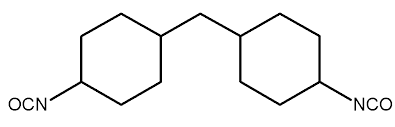
H12MDI
H12MDI

Hydrophobic and Clear Thermoplastic Polyurethane

Title: CLEAR HYDROPHOBIC TPU

 Number/Link: WO2014/121174

Applicant/Assignee: Lubrizol

Publication date: 7-08-2014

Gist”: A hydrophobic, clear and low density TPU is prepared from 4,4’MDI, a dimer acid-based polyol and a mixture of “non-stacking” chain extenders.

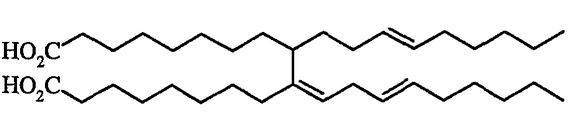
Why it is interesting: Most commercial TPUs are hydrophilic to a certain extend and because of phase separation and partial crystallization are often transparent but not clear. The current invention teaches a highly hydrophobic and clear TPU made form 4,4′ MDI, a polyester polyol produced by reacting a C36 dimerized fatty acid (“dimer acid”) with 1,6-hexanediol and a chain extender mixture consisting of 1,12-dodecanediol and 2-butyl,2-ethyl propanediol or  1,4-cyclohexanedimethanol (all preferred). Hardblock content in the examples is between 25 and about 45% resulting in a shore A hardness range of about 75 to 95. No thermal data are given.
While this is no doubt an interesting material, I expect this to be a single phase glass with a relatively low Tg and therefore less useful for structural applications.

Example of a C36 dimer acid

Example of a C36 dimer acid


Thermoplastic Polyurethane with a Percisely Controlled Biodegradation Rate

Title: PROCESS FOR MAKING BIODEGRADABLE AND/OR BIOABSORBABLE POLYMERS

 Number/Link: WO2014/004334

Applicant/Assignee: Lubrizol

Publication date: 03-01-2014

Gist”: Two sets of parameters are given (and claimed) which, when iteratively adjusted, allow to independently modify the mechanical properties and biodegradation rate of a TPU.

Why it is interesting: Many biomedical materials for implants such as screws, bone plates, tissue scaffolds, pins etc need high mechanical properties but also a controlled biodegradation rate which can vary from weeks to years.  According to this case the precise control of the degradation rate is not possible with currently available bio-polymers.  The invention claims two sets of parameters one which controls the physical properties of a TPU like the molecular weight, harblock content, crystallinity etc, and another set which controls the biodegradation rate like the amount of ‘hydrolyzable units’ in the backbone, hydrophilicity ect. It is claimed that both mechanical properties and degradation rate can be independently controlled by adjusting one or more parameters of each set. In the examples TPUs are prepared from HMDI, 1,4-butane diol and poly(lactide-co-caprolactone) diols where the lactide is the hydrolyzable unit.

A poly(lactide-co-caprolactone)

A poly(lactide-co-caprolactone)

  • Pages

  • Categories

  • Enter your email address to follow this blog and receive notifications of new posts by email.

    Join 259 other subscribers
  • Follow Innovation in PU on Twitter