Hydrophobic and Clear Thermoplastic Polyurethane

Title: CLEAR HYDROPHOBIC TPU

 Number/Link: WO2014/121174

Applicant/Assignee: Lubrizol

Publication date: 7-08-2014

Gist”: A hydrophobic, clear and low density TPU is prepared from 4,4’MDI, a dimer acid-based polyol and a mixture of “non-stacking” chain extenders.

Why it is interesting: Most commercial TPUs are hydrophilic to a certain extend and because of phase separation and partial crystallization are often transparent but not clear. The current invention teaches a highly hydrophobic and clear TPU made form 4,4′ MDI, a polyester polyol produced by reacting a C36 dimerized fatty acid (“dimer acid”) with 1,6-hexanediol and a chain extender mixture consisting of 1,12-dodecanediol and 2-butyl,2-ethyl propanediol or  1,4-cyclohexanedimethanol (all preferred). Hardblock content in the examples is between 25 and about 45% resulting in a shore A hardness range of about 75 to 95. No thermal data are given.
While this is no doubt an interesting material, I expect this to be a single phase glass with a relatively low Tg and therefore less useful for structural applications.
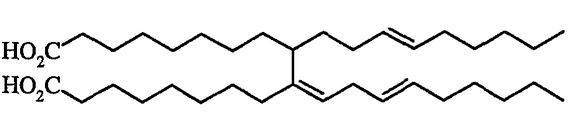
Example of a C36 dimer acid

Example of a C36 dimer acid


Polyurethane Dispersions with “Reversible Drying”

Title: RADIATION CURABLE AQUEOUS COMPOSITIONS WITH REVERSIBLE DRYING

 Number/Link: WO2014/111349

Applicant/Assignee: Allnex

Publication date: 24-07-2014

Gist”: PUDs from hydrophilic, low molecular weight PU can be re-dispersed after drying.

Why it is interesting: It is known that PUDs will coalesce into an insoluble film when dried, at least when the temperature is over the ‘minimum film forming temperature’ or MMFT.  This behaviour, while being useful in most coating- and adhesives applications, can be problematic when the PUDs are used for jet-printing inks because of irreverisble blocking of the print-head nozzles.  According to this invention re-dispersible PUDs can be made when the PU used is both sufficiently hydrophilic and of a low average molecular weight (pref. an Mn between 1000 and 5000, with a polydispersity between 2 and 4). The PU does need to be radiation curable so it can be crosslinked after drying.  In the examples a low NCO prepolymer is prepared from 1,6-hexanediisocyanate (HDI), 2,2-dimethylolpropionic acid, some polyester or polycarbonate polyol and an acrylic chainstopper like a propoxylated trimethylolpropane diacrylate. The (viscous) prepolymer is dispersed and neutralized by adding water containing NaOH or triethylamine. After drying the PUDs of the invention can be re-dispersed in water at 25°C.

Film-forming PU dispersion.

Film-forming PU dispersion.

Classic PU Patent of the Month: The First SMPUs (1988)

Title: Shape memory polymer foam.  – and – Shape memory polyurethane elastomer molded article.

 Number/Link: EP0361418 and EP0361419

Applicant/Assignee: Mitsubishi Heavy Industries

Publication date: 27-09-1989

Gist”: The first shape memory polyurethane foams and elastomers

Why it is interesting: Shape memory polymers are so-called “smart materials” that remain in a deformed shape until a trigger (usually an increase in temperature) makes them return to their original  (“memorized”) shape. In the 1980s these materials were more of a curiosity, only used in some niche applications such as heat shrinkable tubing. Currently however a lot of academic and industrial research is done on these materials, mostly driven by medical applications (e.g. stents, orthopedic casts, self-tightening sutures etc). And not surprisingly a lot of current SMPs are based on polyurethanes (SMPUs).  Interest in shape memory materials was stimulated significantly by the invention of the first SMPUs by Mitsubishi H.I. Ltd. They filed two patents covering both shape memory foams and elastomers. The first SMPUs were based on a di-isocyanate like 4,4′-MDI, a diol like PPG700 and a chain extender like bisphenol-A, and were formulated over a range of Tg’s. The foamed materials were blown with a physical blowing agent (i.e. not water) so that all materials can be considered thermoplastics.

SMP transition from temporary shape (spiral) to permanent shape (rod).  (Angew. Chem. Int. Ed. 2002, 41, 2034 ± 2057)

SMP transition from temporary shape (spiral) to permanent shape (rod). (Angew. Chem. Int. Ed. 2002, 41, 2034 ± 2057)

  • Pages

  • Categories

  • Enter your email address to follow this blog and receive notifications of new posts by email.

    Join 259 other subscribers
  • Follow Innovation in PU on Twitter