Triptycene Chain Extenders

Title: TRIPTYCENE MONOMER AND TRIPTYCENE CONTAINING POLYESTERS AND POLYURETHANES

 Number/Link: US20150191408

Applicant/Assignee: not yet recorded. Research supported by US Army

Publication date: 9-07-2015

Gist”: A novel primary diol derived from triptycene is useful as chain extender for polyurethanes and polyesters.

Why it is interesting: Polymers with increased mechanical properties and stiffness can be obtained by incorporating rigid structures in the polymer chain.  This however also results in increased glass transition temperature and reduced ductility because of reduced chain flexiblity and entanglements.  According to this invention polyurethanes (and copolyesters) with high modulus and good ductility at low temperatures can obtained by using triptycene-1,4-hydroquinone-bis(2-hydroxyethyl ether) or TD. In and example TD capped with PEG400 is reacted with a 4,4’MDI- PTMEG1000 prepolymer.  The resulting material indeed has a very low softblock Tg of  -65ºC and a much higher Y modulus compared to a PU made with HQEE as chain extender. According to the inventors the PU is highly suitable as a matrix material in KEVLAR or UHMWPE fiber composites.
In my opinion this is a very interesting chain extender as it appears to prevent H-bond formation and increase molar volume thereby substantially decreasing Tg. However lack of availability, and (most probably) price, will prevent this from becoming mainstream anytime soon.
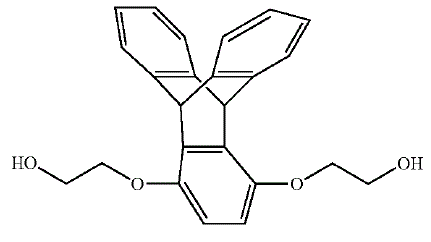
Tryptycene-1,4-hydroquinone-bis(2-hydroxyethyl ether)

Triptycene-1,4-hydroquinone-bis(2-hydroxyethyl ether)


Polyols from Epoxies and Cardanol

Title: CARDANOL MODIFIED EPOXY POLYOL

 Number/Link: WO2015/077944  WO2015/077945 WO2015/078178

Applicant/Assignee: Dow

Publication date: 4-06-2015

Gist”: Polyols are prepared by reacting an epoxy resin with  cashew nutshell liquid.

Why it is interesting: Cardanol is the main component of  cashew nutshell liquid which is a by-product of cashew nut processing. It is a “surfactant-like” phenolic compound which, when reacted with a polyepoxide, will result in a polyol with sec-OH groups. When used in polyurethane formulations these polyols will (unsurprisingly) be slow-reacting, highly hydrophobic and show compatibilizing properties vs apolar compounds. Dow have therefore filed three patent applications on PU systems containing these polyols: one on slowly-reacting PU systems for filament winding, one on highly hydrophobic PU elastomers and one on asphalt-PU compositions.
These are interesting polyols but they could be hard to process in my opinion.

Cardanol is reacted with bisphenol-A diglycidylether resulting in a diol according to the invention

Cardanol is reacted with bisphenol-A diglycidylether resulting in a diol according to the invention

Syntactic Polyurethane Elastomers

Title: SYNTACTIC POLYURETHANE ELASTOMERS FOR USE IN SUBSEA PIPELINE INSULATION

 Number/Link: WO2015065769 WO2015065770 WO2015065771 WO2015065772

Applicant/Assignee: Dow

Publication date: 7-05-2015

Gist”: Zn/Zr catalyzed syntactic elastomers for subsea pipeline insulation

Why it is interesting: Conventional polyurethane rigid foams cannot be used for the insulation of subsea pipelines because the foams would collapse under the pressure and they are too brittle to be bent.  For these reasons syntactic elastomers can be a better choice for this application. Syntactic polyurethane elastomers consist of a solid PU matrix containing up to 50% (wt/wt) of hollow glass microspheres. The catalyst of choice to produce these materials is phenylmercury neodecanoate.  However because of regulatory pressure other catalyst systems are now being used.  The gist of these four patent applications appears to be the use of a mixture of a zinc carboxylate with a small amount of zirconium carboxylate as a replacement for the organomercury catalyst, but this is not the main claim (probably because of non-patentability). Instead the WO..69 case is about the use of polymer polyols in these systems,  the WO..70 case is about the use of low unsat polyols, WO..71 is about a special type of morphology and WO..72 about the use of prepolymers.

Phenylmercury neodecanoate

Phenylmercury neodecanoate

  • Pages

  • Categories

  • Enter your email address to follow this blog and receive notifications of new posts by email.

    Join 259 other subscribers
  • Follow Innovation in PU on Twitter