Polyurethane Foams with Reduced Acetaldehyde Emissions

Patent Title: POLYURETHANES WITH REDUCED ALDEHYDE EMISSION

 Number/Link: WO2015/189095

Applicant/Assignee: BASF

Publication date: 17-12-2015

Gist”: A polymer with pending -O-NH2 groups is used as additive

Why it is interesting: The reduction of VOC emissions, especially emissions of aldehydes from PU foams, remains an important topic of research. A number of solutions have been proposed, for example the use of polyamines as scavengers as discussed before. There still appears to be a need for improvement however, especially for the reduction of acetaldehyde emissions. According to this invention acetaldehyde emissions can be reduced by using a relatively high mole-weight polymer with pending aminooxy groups as an additive during foaming. In an example a copolymer of 4-aminooxymethylstyrene and methacrylic acid with a Mn of about 15,000 is used as an additive.

Aminooxymethylstyrene

4-aminooxymethylstyrene

Novel Aliphatic Polyester Polyols for TPU

Patent Title: POLYESTER POLYOLS AND POLYURETHANES

 Number/Link: WO2015/185744

Applicant/Assignee: DSM

Publication date: 10-12-2015

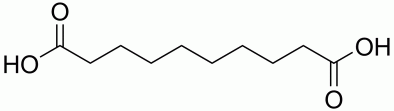
Gist”: Polyester polyols from succinic- and sebacic acid mixtures

Why it is interesting: Aliphatic polyester polyols used in polyurethane elastomers, are usually based on adipic acid and diols like MEG, DEG, butanediol or mixtures of these. Since recently, succinic acid has become a commercially avaible renewable compound and it makes sense to use it in polyester polyol production. Replacing adipic acid by succinic acid however, results in polyesters with a reduced hydrolysis resistance (at the same polyol molecular weight).  According to this invention this can be solved by using blends of succinic acid with C8 to C36  diacids, most preferably with sebacic (C10) acid.
Not a spectacular innovation and probably not as such patentable but a solid, useful idea.

Sebacic acid

Sebacic acid

Superhydrophilic Polyurethane Coatings

Patent Title: HYDROPHILIC ANTI-FOG COATINGS

 Number/Link: US2015/0344725

Applicant/Assignee: InnoSense

Publication date: 3-12-2015

Gist”: A hydrophilic anti-fog coating is pepared by incorporating silica particles  and organosilicate micelles

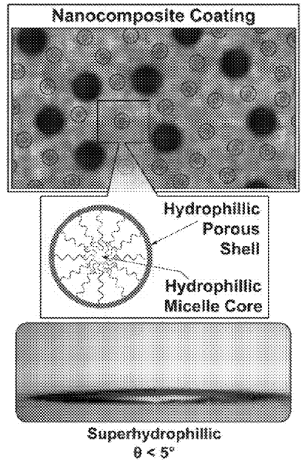
Why it is interesting: A superhydrophilic coating composition is made from a polyurethane prepolymer together with 1-5% (w/w) of a ~30nm monodisperse colloidal silica and up to 10% (v/v) of organosilicate micelles having a hydrophilic porous ‘shell’ and a (pref.) hydrophilic ‘core’, all in a solvent. The composition is said to be especially useful for anti-fog coatings on optically-clear plastic substrates (polycarbonate, polyurethane, polyester..).  According to the theory the porous shell of the micelles draws water away from the coated surface while the micelle cores act as a water reservoir.  Very clever.

Superhydrophilic coating accordin to the invention

Superhydrophilic coating according to the invention

  • Pages

  • Categories

  • Enter your email address to follow this blog and receive notifications of new posts by email.

    Join 259 other subscribers
  • Follow Innovation in PU on Twitter