Polycarbonate PU Foams with Reduced VOC Emissions

Title: POLYURETHANE FOAMS BASED ON POLYETHER CARBONATE POLYOLS

Number/Link: WO2017/085201 (German)

Applicant/Assignee: Covestro

Publication Date: 26-may-2017

“Gist”: Use of urea reduces the formation of propylenecarbonate from polycarbonate polyols

Why it is interesting: Covestry is betting heavily on polyethercarbonate polyols for use in polyurethane foams, using the carbon-negative footprint as a selling point. The use of polyethercarbonate polyols in PU foams can, however, result in the formation of propylenecarbonate resulting from a retro reaction promoted by conventional amine catalysts. Propylenecarbonate will contribute to the total VOC emissions of foams and other materials. According to this invention, the retro reaction can -surprisingly- be prevented or reduced by using urea or urea-derivatives in the foam formulation. In the examples urea and dimethylaminopropylurea are used together with a tin catalyst,  polyethercarbonate polyols and TDI to produce flexible foams with reduced propylenecarbonate content.

Propylenecarbonate



TPU from Oleic Acid

Title: RENEWABLY DERIVED THERMOPLASTIC POLYESTER-BASED URETHANES AND METHODS OF MAKING AND USING THE SAME

Number/Link: US2017/0145145

Applicant/Assignee: Trent University

Publication Date: 25-may-2017

“Gist”: Thermoplastic polyurethane made entirely from C9 monomers derived from oleic acid.

Why it is interesting: Azaleic acid can be prepared by oxidative cleavage of the oleic acid double bond.  Azaleic acid in turn can be converted to 1,9-nonanediol and to 1,7-heptamethyldiisocyanate via azides and Curtius rearrangment (see previous blog post). In this invention a polyester diol is prepared from azaleic acid and nonanediol and is then reacted with 1,7-heptamethylenediisocyanate together with nonanediol as chain extender, resulting in a phase-separated TPU. Best properties are obtained when the nonanediol is first prepolymerized with the diisocyanate. The TPU is said to degrade without cytotoxic degradation products, and is therefore useful for medical applications such as resorbable implants and scaffolds.
Related case: US2017/0145146.

Oleic Acid


Thiol-Crosslinked Poly(hydroxyurethanes)

Title: METHOD FOR PRODUCING OR CURING POLYMERS USING THIOL-ENE POLYADDITION REACTIONS

Number/Link: W2017/081120

Applicant/Assignee:  Henkel

Publication Date: 18-05-2017

“Gist”: Unsaturated PHU are crosslinked using polythiols

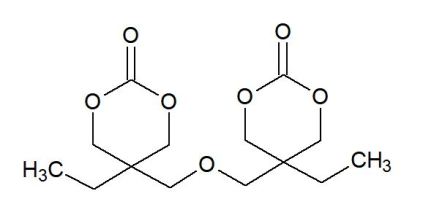
Why it is interesting: The invention is about poly(hydroxyurethanes) (PHU) containing alkylene groups that are crosslinked using thiol-ene ‘click’ polyaddition reactions. The unsaturated PHU are first prepared by aminolysis of cyclocarbonates using unsaturated amines. In an example di-trimethylolpropane is converted to di-trimethylolpropanedicarbonate using ethylchloroformiate.  The di-TMPDC is then reacted with 3-aminopropylvinylether to prepare the PHU, which is then crosslinked using pentaerithritol-tetra(3-mecaptopropionate) in the presence of a photoinitiator and UV light.  The invention is said to be useful for isocyanate-free adhesive- and coating systems.

Di-trimethylolpropanedicarbonate

  • Pages

  • Categories

  • Enter your email address to follow this blog and receive notifications of new posts by email.

    Join 259 other subscribers
  • Follow Innovation in PU on Twitter