Renewable Polyols from “Distillers Grains”

Title: PRODUCTION OF POLYOLS USING DISTILLERS GRAINS AND PROTEINS AND LIGNIN EXTRACTED FROM DISTILLERS GRAINS

 Number/Link: US2014/200324

Applicant/Assignee: EMGPI PROC and PITTSBURG STATE UNIVERSITY 

Publication date: 17-07-2014

Gist”: Dried distillers grains are transamidated and then alkoxylated to form a polyol useful for rigid polyurethane spray foams.

Why it is interesting: ‘Distillers grains’ are a by-product of ethanol production and are currently avaible in huge quatities due to the state-sponsored bio-ethanol production in the US.  Most of the product is used as animal feeds because of the high levels of nutrients. Dried distillers grain (DDGS) contains about 30% protein, about 30% fibers (cellulose, hemicellulose and lignin) and about 30% lipids, ash and water. According to this invention DDGS can be turned into polyols by first reacting the (solid) DDGS with diethanolamine at elevated temperature and pressure (about 200°C and 3.5 MPa) and breaking down the proteins in amino-amides. The resulting liquid can subsequentlly be epoxidized with propylene oxide resulting in a polyol which is supposedly highly reactive and useful for polyurethane rigid spray foams.
Personally I find it hard to believe that a decent reproducible foam can be made with such a horrible mixture.
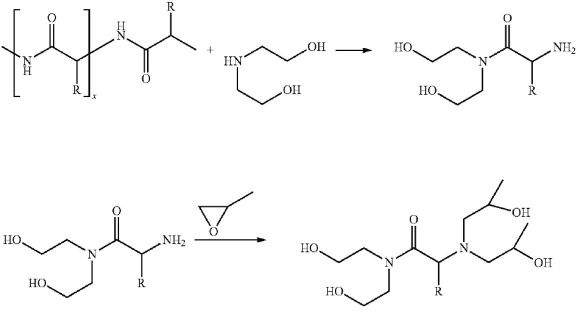
Transamidation of protein with subsequent epoxidation.

Transamidation of protein with subsequent epoxidation.

Fuel Resistant Polyurea

Title: POLYUREA COMPOSITIONS AND METHODS OF USE

 Number/Link: US20140171587

Applicant/Assignee: PRC DESOTO

Publication date: 19-06-2014 (priority PCT)

Gist”: Sulfur-containing polyformal polyols are prepolymerized with aliphatic diisocyanates and then cured with aromatic amines.

Why it is interesting: Sulfur-containing polyformal polyols are prepared from thiodiglycol and paraformaldehyde using acidic catalysis.  The polyols are then reacted with 4,4′-dicylcohexyl diisocyanate (H12MDI) to form a prepolymer which is subsequently cured with an aromatic amine like dimethylthiotoluenediamine. The resulting material is water and fuel resistant and can be used as a sealant in the aerospace industry.

H12MDI-thiodiglycol-polyformal adduct

H12MDI-thiodiglycol-polyformal adduct

Flexible- and Viscoelastic Foams from CO2-Based Polyols

Title: HIGH STRENGTH POLYURETHANE FOAM COMPOSITIONS AND METHODS

 Number/Link: WO2014/074706

Applicant/Assignee: Novomer

Publication date: 15-05-2014

Gist”: The mechanical properties of flexible foams can be improved by replacing up to 50% of the polyol with CO2-based polycarbonate polyols.

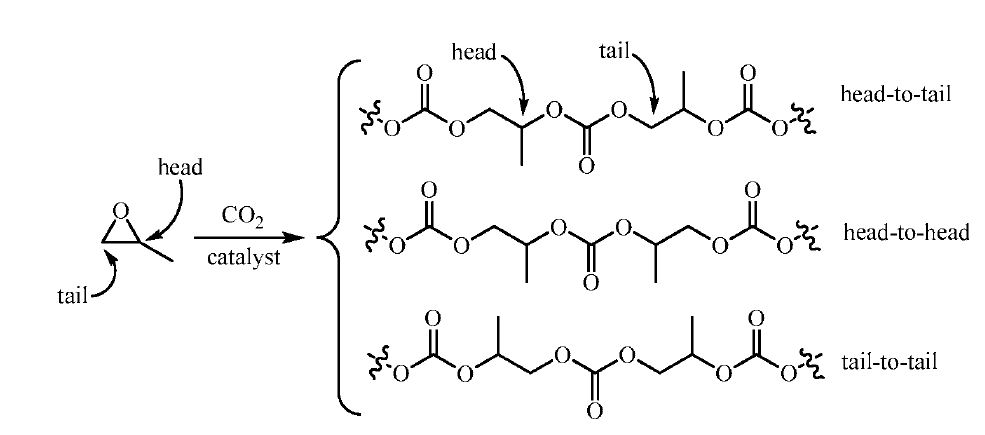
Why it is interesting: Novomer (http://www.novomer.com) is a ‘sustainable chemistry company’ which produces aliphatic polycarbonate polyols from CO2 and epoxides. In this 215 page patent application they claim that hardness and mechanical properties viz. tensile- and tear strength of flexible and VE foams are improved by replacing between 2 and 50% of the polyol by their polycarbonate polyol. Other properties are supposedly not affected much, although resilience (e.g.) clearly drops for HR foams.
While the first claim may be technically new, it is – in my opinion- not patentable because not surprising to “a person skilled in the art”.

Reaction of CO2 and PO showing various 'head-to-tail' orientations

Reaction of CO2 and PO showing various ‘head-to-tail’ orientations

  • Pages

  • Categories

  • Enter your email address to follow this blog and receive notifications of new posts by email.

    Join 259 other subscribers
  • Follow Innovation in PU on Twitter