Novel Aliphatic Polyester Polyols for TPU

Patent Title: POLYESTER POLYOLS AND POLYURETHANES

 Number/Link: WO2015/185744

Applicant/Assignee: DSM

Publication date: 10-12-2015

Gist”: Polyester polyols from succinic- and sebacic acid mixtures

Why it is interesting: Aliphatic polyester polyols used in polyurethane elastomers, are usually based on adipic acid and diols like MEG, DEG, butanediol or mixtures of these. Since recently, succinic acid has become a commercially avaible renewable compound and it makes sense to use it in polyester polyol production. Replacing adipic acid by succinic acid however, results in polyesters with a reduced hydrolysis resistance (at the same polyol molecular weight).  According to this invention this can be solved by using blends of succinic acid with C8 to C36  diacids, most preferably with sebacic (C10) acid.
Not a spectacular innovation and probably not as such patentable but a solid, useful idea.
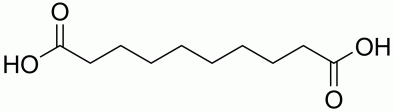
Sebacic acid
Sebacic acid

Natural Oil Polyols Using Metathesis Chemistry

Patent Title: METATHESIZED TRIACYLGLYCEROL POLYOLS FOR USE IN POLYURETHANE APPLICATIONS AND THEIR RELATED PROPERTIES

 Number/Link: US2015/0337073

Applicant/Assignee: Trent University

Publication date: 26-11-2015

Gist”: Palm oil is metathesized before hydroxylation.

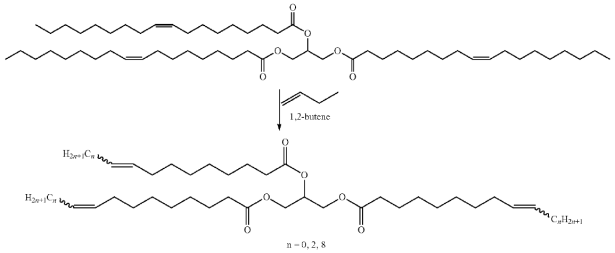
Why it is interesting: Natural-oil based polyols (NOPs) prepared from unsaturated plant oils are well known in the PU industry. In this case however, the oil is first modified into a ‘metathesized triacylglycerol’ by cross-metathesis using (e.g.) 1,2-butene and an appropriate catalyst. The result is a complex mixture of triglycerids, the unsaturations of which are then epoxidized and hydrolyzed into the final polyol.  In the examples palm-oil metathezised triacylglycerol (PMTAG) is compared to a commercially available soy-oil polyol when used to perpare both flexible and rigid foams. While the chemistry is interesting there does not appear to be much advantage to this type of NOP.

Metathesis reaction of triolein with butene

Metathesis reaction of triolein with butene

TPU from Asymmetric Chain Extenders

Patent Title: THERMOPLASTIC POLYURETHANE

 Number/Link: WO2015/173337

Applicant/Assignee: Henkel

Publication date: 19-11-2015

Gist”: TPU is made using diols with 1 prim- and one sec-OH group

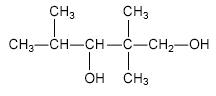
Why it is interesting: Thermoplastic polyurethanes (TPU) have many desirable properties but are notoriously difficult to process: they need a high processing temperature (>160°C ) and have a high melt viscosity requiring high shear processing equipment. According to the current invention the melt viscosity can be greatly reduced by using an asymmetric diol as chain extender (i.e. with one pimary and one secondary hydroxyl group) instead of a conventional symmetric diol. In the examples polyester-MDI TPUs extended with asymmetric diols (e.g. 1,3-butanediol or 2,2,4-trimethyl-1,3-pentanediol)  are shown to have a much lower melt viscosity compared to TPU extended with 1,4-butanediol. These TPUs are especially useful as hotmelt adhesives.

2,2,4,-trimethyl-1,3-pentanediol

2,2,4,-trimethyl-1,3-pentanediol

  • Pages

  • Categories

  • Enter your email address to follow this blog and receive notifications of new posts by email.

    Join 259 other subscribers
  • Follow Innovation in PU on Twitter