Monodisperse Polymer Polyol

Patent Title: PROCESS MAKING POLYMER POLYOL HAVING MONODISPERSE DISPERSED POLYMER PARTICLES

 Number/Link: WO2017/172417

Applicant/Assignee:  Dow

Publication date: 5 october 2017

Gist”: Polymer polyol with a “monodisperse” particle size distribution is prepared by using a specific seeding dispersion

Why it is interesting: It is well known that the use of polymer polyols in flexible polyurethane foam formulations can result in improved airflow and load bearing properties. For optimal results the average particle size of the dispersed polymer needs to be similar to the cell wall thickness. According to this invention a SAN polymer polyol with a controlled and narrow particle size distribution can be prepared by using a seed dispersion which consists of an unsaturated macromer which, together with SAN particles of a particle size between 50 and 500 nm, is dispersed in a base polyol. The macromer is a PO/EO polyether with a (pref.) mole weight of 11000 to 14000 Da and having 4-5 OH groups and 1-2 reactive double bonds. The polymer polyol is prepared by dispersing the seed dispersion in the base polyol together with styrene, acrylonitrile and a solvent (e.g. isopropanol). After polymerization of the monomers the solvent is removed, resulting in a polymer polyol with at least 30% solids, average particle size of 1-3 μm and a size span of 1.25. In the examples the macromer is prepared by capping 1-2 OH groups of a 6-functional 90/10 PO/EO polyol with 3,3-isoprenyl-α,α-dimethylbenzylisocyanate.
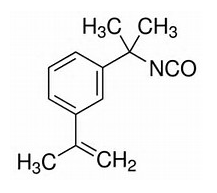
3,3-isoprenyl-α,α-dimethylbenzylisocyanate


Viscoelastic Polyurethane Elastomers

Title:  IMPACT PROTECTION FOAM

Number/Link: US2017/0233519

Applicant/Assignee: Dow

Publication Date: 17 august 2017

“Gist”: Viscoelastic foams are prepared from MDI, castor oil and a hydrophilic polyether polyol.

Why it is interesting: According to this invention energy absorbing foams with relatively low density and a low hardness and resilience in the temperature range from about -10 to +40°C, can be produced by reacting a blend of hydrophilic and hydrophobic polyols containing castor oil, about 0.5 pbw water and some catalyst and chain extender with MDI.  The examples show foams of about 500 kg/m³ with hardness below shore 50A and ball rebound below 15% at both -10 and +23°C. The foams are said to be useful for impact-protective garments.

Castor oil

Castor oil component

PU Flexible Foams with Reduced Acetaldehyde Emissions

Title: METHOD FOR THE REDUCTION OF ALDEHYDE EMISSION IN POLYURETHANE FOAM

Number/Link: WO2017/134296

Applicant/Assignee: Huntsman

Publication Date: 10 August 2017

“Gist”: Cyanoacetamide is used as aldehyde scavenger

Why it is interesting: Reduction of aldehyde emissions from (especially flexible) polyurethane foams remains an important issue and has already been discussed a number of times on this blog. According to this case the use of (pref) 0.05 to 0.5 pbw of cyanoacetamide in a flexible foam formulation will reduce the emission of formaldehyde, acetaldehyde, propionaldehyde, and possibly of higher aldehydes as well.
While an interesting compound, the use of cyanoacetamide in polyurethanes is not new and the effect is hardly surprising.

Cyanoacetamide


  • Pages

  • Categories

  • Enter your email address to follow this blog and receive notifications of new posts by email.

    Join 259 other subscribers
  • Follow Innovation in PU on Twitter