Classic PU Patent of the Month: Polyurethane-Polyurea RIM Elastomers (Bayer 1976)

Title: VERFAHREN ZUR HERSTELLUNG VON ELASTISCHEN FORMKOERPERN

 Number/Link: DE262295 (German)

Applicant/Assignee: Bayer

Publication date: 24-11-1977

Gist”: Use of DETDA  in one shot PU-PUA RIM.

Why it is interesting: This is the invention that for the first time allowed the production of large reaction injection moulded (RIM) polyurea articles with a very short demould time. Apart from advances in mixing head design which allowed for fast and accurate mixing and advances in mould design, polyurea RIM was made possible by the development of specific diamine chain extenders.  Bayer found that aromatic diamines containing one alkyl group in o-postion to a first amino group and two alkyl groups in o-position to a second amine group, where at least two of the alkyl groups contain 2 or more carbon atoms, have the correct reactivity for a one shot RIM process when used together with conventional polyether polyols, MDI and catalysts. A preferred example of such a diamine is diethyltoluenediamine (DETDA). The use of DETDA in one shot RIM allowed for the production of  parts up to 10 kg with a demould time of 30 seconds.
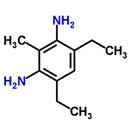
DETDA

DETDA

Thermal Engine Encapsulation with Polyurethane Foam

Title: THERMAL INSULATION OF AN INTERNAL COMBUSTION ENGINE

 Number/Link: WO2014/195153 (German)

Applicant/Assignee: BASF

Publication date: 11-12-2014

Gist”:  Engine parts are encapsulated in PU foam using moulds.

Why it is interesting: Encapsulating (part of) motor car engines with heat-insulating rigid PU foam is useful because it can reduce fuel consumption and exhaust. When the mass of the foam is increased (e.g. by filling with BaSO4) the encapsulation can also reduce noise levels. BASF has been working on this concept for more than 15 years now (see e.g. DE19935335) and the current application only relates to a process improvement:  an engine part is brought into a closed mould leaving a gap between part and mould which is then filled with PU foam. This is an interesting concept but I wonder if it is actually used in current motor cars.  And if not, why not?

Car with thermally encapsulated engine.

Car with thermally encapsulated engine.


Polyurethane-NCC Composites

Title: POLYURETHANE COMPOSITES COMPRISING NANOCRYSTALLINE CELLULOSE AND METHOD FOR IMPROVING PROPERTIES OF POLYURETHANES THEREOF

 Number/Link: WO2014/190428

Applicant/Assignee: Celluforce

Publication date: 4-12-2014

Gist”: A small amount of nanocrystalline cellulose improves mechanical properties of polyurethanes

Why it is interesting: Nanocrystalline cellulose or NCC is cellulose in the form of nano-scale crystals or fibrils produced from woodpulp. A few years ago NCC was hailed as a disruptive new “wonder material” with the potential to replace metal and make existing plastics obsolete. The current patent application claims the use of NCC in polyurethanes, added in amounts of (preferably) less than 1% to either the polyol or isocyanate stream. Both tensile and elongation values of the PU are said to improve.  While this may well be true and NCC is no doubt an interesting material this case is most probably not patentable.  Too little, too late.

Nanocrystalline cellulose "whiskers"

Nanocrystalline cellulose “whiskers”


  • Pages

  • Categories

  • Enter your email address to follow this blog and receive notifications of new posts by email.

    Join 259 other subscribers