Polyurethane-Polyamides from Dimer Diacids

Title: A POLYOL BASED ON DIMER FATTY ACID RESIDUES AND THE CORRESPONDING POLYURETHANES

 Number/Link:WO2015/097433

Applicant/Assignee: Croda

Publication date: 2-07-2015

Gist”: Polyurethane/polyamide elastomers based on dimer diacids and long chain dicarboxylic acids

Why it is interesting: Polyurethane elastomers (and thermoplastic elastomers) based on dimer diacids or dimer diols are very hydrophobic and hydrolysis resistant but are relatively soft with lowish mechanical properties. According to this invention, using a blend of a dimer diacid (or -diol) and a (semi-) crystalline C17 to C32 dicarboxilic acid (or -diol) results in elastomers with greatly improved hardness and tensile strength while retaining flexibility and hydrolysis resistance. The C17 to C32 dicarboxylic acids can be prepared by a self-metathesis reaction of unsaturated fatty acid esters.  In the examples a C36 dimer diacid is used together with 1,18-octadodecanoic acid (prepared by metathesis from methyl oleate).  This is reacted ‘one shot’ with 4,4′ MDI and hexanediol or DEG, resulting in 85 shore A elastomers with high elongation and hydrolysis resistance.
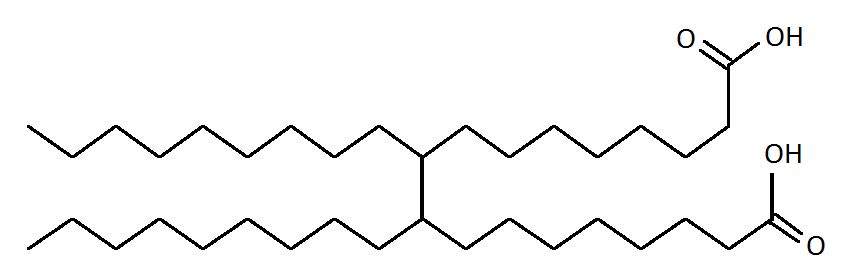
A C36 dimer diacid
A C36 dimer diacid

TPU from Three Types of Polyol and TODI

Title: THERMOPLASTIC POLYURETHANE FOR SEAL APPLICATIONS

 Number/Link:WO2015/090916 (German)

Applicant/Assignee: Carl Freudenberg

Publication date: 25-06-2015

Gist”: TPU based on blend of a polyester- polyether- and polycarbonate diols has exceptional properties

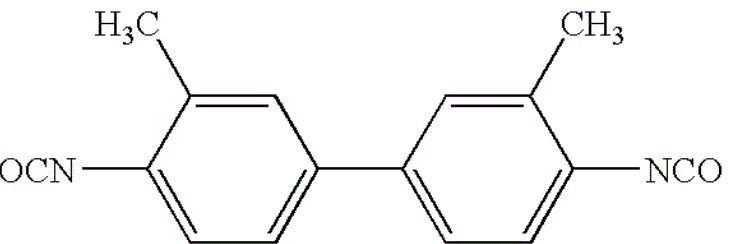
Why it is interesting: According to this application, TPUs prepared from blends of polyether, polyester and polycarbonate diols, result in materials with very high hydrolysis resistance, mechanical properties, high- ánd low temperature resistance and with excellent processing properties. In the examples 2000 MW polyether-, polycarbonate- and polycaprolactone diols are blended, reacted with toluidinediisocyanate (TODI) and subsequently extended with butanediol.  Surprisingly there appears to act some kind of synergy resulting in properties higher than would be expected from the individual polyol components.

3,3'-Dimethyl-4,4'-Biphenyldiisocyanate (TODI)

3,3′-Dimethyl-4,4′-Biphenyldiisocyanate (TODI)

Flexible Foams with Improved Thermal Comfort

Title: IN-SITU GELATINOUS TRIBLOCK COPOLYMER ELASTOMERS IN POLYURETHANE FLEXIBLE FOAMS

 Number/Link:US2015/0166756

Applicant/Assignee: Peterson Chemical Technology

Publication date: 18-06-2015

Gist”: Gelatinous styrenic block copolymers are incorporated in flexible foams to increase thermal conductivity.

Why it is interesting: High viscosity styrenic triblock copolymer resins (like SBS, SEBS, SIS etc), plasticized with mineral oils, are added to flexible foam-forming compositions. The heat of the foam-forming reaction is said to be sufficient to further polymerize the resins and melt the styrene-block such that the block copolymers get integrated into the polyurethane matrix. The resulting foams show increased load bearing and improved thermal conductivity. These systems could improve the thermal comfort properties of cushioning materials, especially those of viscoelastic foams.

Poly(styrene-butadiene-styrene) or SBS.

Poly(styrene-butadiene-styrene) or SBS.

  • Pages

  • Categories

  • Enter your email address to follow this blog and receive notifications of new posts by email.

    Join 259 other subscribers