Polyurethane “Combination Foam”: a TPU/PU Composite

Title: KOMBINATIONSSCHAUM

 Number/Link:  WO2014/023794   (German)

Applicant/Assignee: BASF

Publication date: 13-02-2014

Gist”: Foamed TPU particles are embedded in a foamed elastomer of the same chemical composition to improve mechanical properties.

Why it is interesting: Foamed, closed-cell TPU particles are incorporated in a foamed, open-cell PU matrix which has a higher density and is produced from essentially the same chemicals, resulting in perfect compatibility and adhesion between the two components.  In the examples 30-40 % (w/w) of expanded TPU particles with a bulk density (“Shüttdichte”) of 89 kg/m³ are incorporated in an elastomer with a density of 200-300 kg/m³. Size of the TPU particles is not given but the preferred size range is 1mm to 2 cm.

Expanded TPU particles by BASF
Expanded TPU particles by BASF

Unique Type of Polyurethane Flexible Foam to Reduce Tyre Noise

Title: TYRE, THE INNER WALL OF WHICH HAS A LAYER OF SPECIFIC POLYURETHANE FOAM

 Number/Link: WO2013/182477 (French)

Applicant/Assignee: Michelin

Publication date: 12-12-2013

Gist”: A layer of flex foam is used to reduce cavity noise in car tyres, the foam being prepared form high EO polyol and 4,4′ MDI.

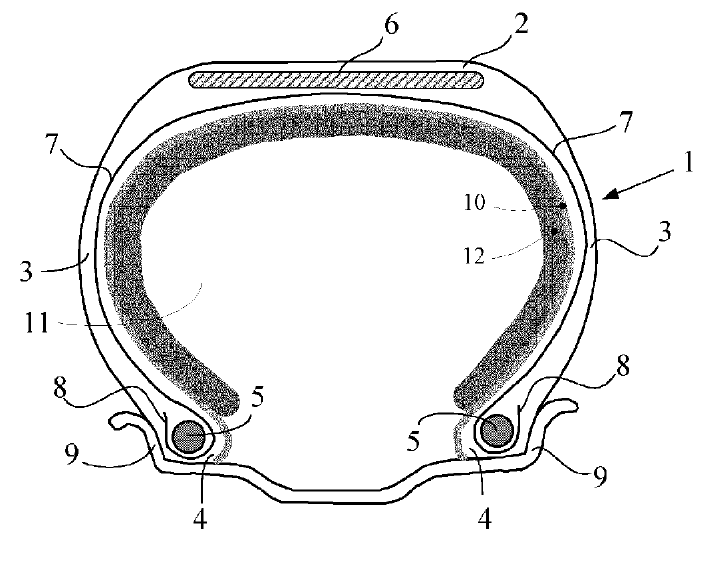
Why it is interesting: An important component of the noise produced by driving vehicules is attributed to resonances in the tyre cavities. It is know that this noise can be reduced by (partly) filling the tyre cavity with PU foam, but the foams are difficult to apply, add too much weight and do not show enough sound absorption. According to this invention these problems can be solved by adhering a layer of a specific flexible foam to the inside of the tire.  The foam has a low density (30 to 60 kg/m³), and absorbs sound at the correct frequency for cavity resonances (190-230Hz).  It is prepared from a prepolymer based on a  70-90% EO polyol and 4.4′ MDI, which is mixed with water and catalyst.  The reacting mixture is poured into a spinning tyre where it cures and adheres to the inside of the cavity.
This foam -inlcuding the prepolymer- was actually invented by myself in 1991: EP547765

Cross-section of foam-lined tire according to the invention.

Cross-section of foam-lined tire according to the invention.

Solid Cast Polyurethane Elastomers Produced with a Highly Specific “Switchable” Catalyst

Title: POLYISOCYANATE POLYADDITION PRODUCTS, A PROCESS FOR PREPARATION THEREOF AND USE THEREOF

 Number/Link: US2013/303720

Applicant/Assignee: Bayer

Publication date: 14-11-2013 (priority PCT/DE)

Gist”: Use of specific acid-bocked amidines as thermo-latent catalysts for cast elastomers.

Why it is interesting: For the production of solid (non-foamed) cast elastomers it is advantageous to use catalysts which specifically promote the NCO – OH reaction and as little as possible side reactions such as NCO – water, dimerization, trimerization, allophanatization etc. It is also advantageous that the catalyst can be ‘switched on’ at a certain temperature so that elastomer systems with a long open time and short cure time can be formulated. According to the current invention this can be accomplished by using an acid blocked amidine, pref. 1,8-diazabicyclo[5.4.0]undec-7ene (DBU) blocked with (pref.) isocrotonic acid (Z-2-butenoic acid), together with a zeolite as water scavenger. The system has the added advantage that no heavy metals are used.

1,8-Diazabicyclo[5.4.0]undec-7-ene (DBU)

1,8-Diazabicyclo[5.4.0]undec-7-ene (DBU)

  • Pages

  • Categories

  • Enter your email address to follow this blog and receive notifications of new posts by email.

    Join 259 other subscribers
  • Follow Innovation in PU on Twitter