Polyurethane Elastomers from Modified Polybutadienols

Patent Title: POLYESTER-MODIFIED POLYBUTADIENOLS FOR PRODUCING POLYURETHANE ELASTOMERS AND THERMOPLASTIC POLYURETHANES

 Number/Link: WO2016/026807  (German)

Applicant/Assignee: BASF

Publication date: 25-02-2016

Gist”: Polybutadiene polyols are capped with caprolactone

Why it is interesting: Liquid hydroxy-terminated polybutadienes have been available for quite a while and their use in polyurethane elastomers and TPUs is known.  However, because of their immiscibility with isocyanates, polyols and most chain extenders they are notoriously difficult to process, resulting in elastomers that often show poor or inconsistent properties. According to this invention the problem can be solved by capping the polybutadienols with a few moles of cyclic ester, preferably with ε-caprolactone. The capped polyols are miscible with e.g. MDI and butanediol and the resulting elastomers show much improved properties compared to both polybutanedienol- and polycaprolactone- based elastomers.
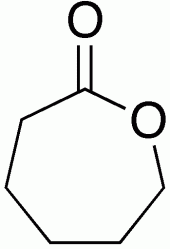
Caprolactone

Epsilon-caprolactone

ε

PUDs for Superhydrophobic Coatings

Patent Title: Vegetable Oil-Modified, Hydrophobic Polyurethane Dispersions

 Number/Link: US20160009852

Applicant/Assignee: Rust-Oleum

Publication date: 14-01-2016

Gist”: PUDs containing saturated monoglycerids

Why it is interesting: Aqueous polyurethane dispersions are popular for use in environmentally friendly coating compositions. Because of the inherent presence of hydrophilic (often acid-) groups to stabilise these dispersions, the resulting coatings often lack hydrolytic stability. According to this invention, this can be improved by incorporating monoglycerids, prepared by reacting vegetable oils with glycerol followed by distillation, into the PU backbone.  A prepolymer is prepared by reacting the monoglicerids, together with a non-isocyanate urethane polyol (prepared from polyamines and monocyclic carbonates), a conventional long-chain polyol and dimethylolpropionic acid, with an excess of isocyanate. The prepolymer is then neutralized with an amine and subsequently reacted with a chain extender in water to make the PUD. Coatings made with these dispersions are said to be superhydrophobic and have a low friction coeficient.

Dimethylolpropionic acid

Dimethylolpropionic acid

Superhydrophilic Polyurethane Coatings

Patent Title: HYDROPHILIC ANTI-FOG COATINGS

 Number/Link: US2015/0344725

Applicant/Assignee: InnoSense

Publication date: 3-12-2015

Gist”: A hydrophilic anti-fog coating is pepared by incorporating silica particles  and organosilicate micelles

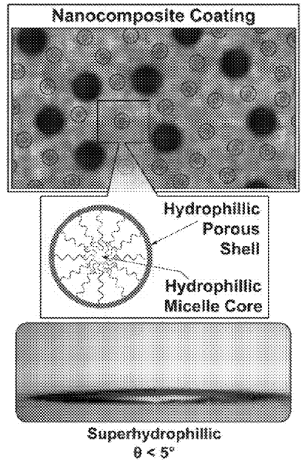
Why it is interesting: A superhydrophilic coating composition is made from a polyurethane prepolymer together with 1-5% (w/w) of a ~30nm monodisperse colloidal silica and up to 10% (v/v) of organosilicate micelles having a hydrophilic porous ‘shell’ and a (pref.) hydrophilic ‘core’, all in a solvent. The composition is said to be especially useful for anti-fog coatings on optically-clear plastic substrates (polycarbonate, polyurethane, polyester..).  According to the theory the porous shell of the micelles draws water away from the coated surface while the micelle cores act as a water reservoir.  Very clever.

Superhydrophilic coating accordin to the invention

Superhydrophilic coating according to the invention

  • Pages

  • Categories

  • Enter your email address to follow this blog and receive notifications of new posts by email.

    Join 259 other subscribers
  • Follow Innovation in PU on Twitter