Superhydrophilic Polyurethane Coatings

Patent Title: HYDROPHILIC ANTI-FOG COATINGS

 Number/Link: US2015/0344725

Applicant/Assignee: InnoSense

Publication date: 3-12-2015

Gist”: A hydrophilic anti-fog coating is pepared by incorporating silica particles  and organosilicate micelles

Why it is interesting: A superhydrophilic coating composition is made from a polyurethane prepolymer together with 1-5% (w/w) of a ~30nm monodisperse colloidal silica and up to 10% (v/v) of organosilicate micelles having a hydrophilic porous ‘shell’ and a (pref.) hydrophilic ‘core’, all in a solvent. The composition is said to be especially useful for anti-fog coatings on optically-clear plastic substrates (polycarbonate, polyurethane, polyester..).  According to the theory the porous shell of the micelles draws water away from the coated surface while the micelle cores act as a water reservoir.  Very clever.
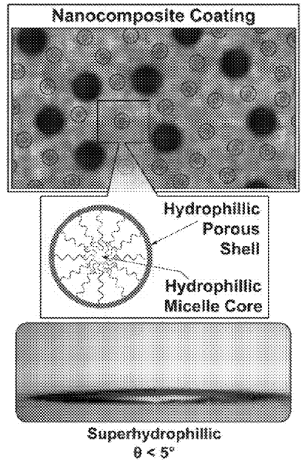
Superhydrophilic coating accordin to the invention

Superhydrophilic coating according to the invention

Classic PU Patent of the Month: Non-Isocyanate Polyhydroxyurethanes by Dow (1957)

Title: Polyhydroxyurethanes

 Number/Link: US3084140

Applicant/Assignee: Dow

Publication date: 2-04-1963

Gist”: bis-cyclocarbonates are reacted with aliphatic polyamines

Why it is interesting: Non-isocyanate polyurethanes (NIPU) are still gaining in popularity – at least in the patent and science literature. The chemistries to make NIPU are far from new as discussed in a previous ‘classic patent of the month’ on this blog.  The most common route to NIPU is by reacting cyclocarbonates with amines resulting in hydroxyurethanes, as was first dicussed in this patent. The intent of the invention was, actually, not to avoid the use of isocyanates but to make hydroxy-group containing polyurethanes which were said to be ‘highly desirable’:  the OH groups can act as points for crosslinking, make the resin more hydrophilic and compatible with certain materials etc.

Preparation of polyhydroxyurethanes according to the invention

Preparation of polyhydroxyurethanes according to the invention

Polyurethane Elastomers containing Polyrotaxanes

Title: CAST-MOLDED HEAT-CURABLE POLYURETHANE ELASTOMER

 Number/Link:  WO2015/159875  (Japanese)

Applicant/Assignee: UBE

Publication date: 22-10-2015

Gist”: 1-10% of a polyrotaxane is incorporated in a hot cast PU elastomer system

Why it is interesting: Polyrotaxanes are molecular systems consisting of a linear polymer which is “threated” through a number of ring-shaped molecules. The rings are prevented from ‘sliding off’ by blocking-molecules at both ends of the “thread”. In this invention polyrotaxanes based on a polycaprolactone thread and cyclodextrin rings (pref.) are incorporated in hot cast elastomer systems in amounts of 1-10% (w/w). Because cyclodextrin rings contain hydroxyl groups they react with the isocyanate incorporating the polyrotaxane in the PU polymer. The systems are said to have processing and property advantages for specific elastomer applications, in this case printer rollers – if I understand the machine translation correctly.

Schematic presentation of a polyrotaxane

Schematic presentation of a polyrotaxane

  • Pages

  • Categories

  • Enter your email address to follow this blog and receive notifications of new posts by email.

    Join 259 other subscribers
  • Follow Innovation in PU on Twitter
