TPU from Oleic Acid

Title: RENEWABLY DERIVED THERMOPLASTIC POLYESTER-BASED URETHANES AND METHODS OF MAKING AND USING THE SAME

Number/Link: US2017/0145145

Applicant/Assignee: Trent University

Publication Date: 25-may-2017

“Gist”: Thermoplastic polyurethane made entirely from C9 monomers derived from oleic acid.

Why it is interesting: Azaleic acid can be prepared by oxidative cleavage of the oleic acid double bond.  Azaleic acid in turn can be converted to 1,9-nonanediol and to 1,7-heptamethyldiisocyanate via azides and Curtius rearrangment (see previous blog post). In this invention a polyester diol is prepared from azaleic acid and nonanediol and is then reacted with 1,7-heptamethylenediisocyanate together with nonanediol as chain extender, resulting in a phase-separated TPU. Best properties are obtained when the nonanediol is first prepolymerized with the diisocyanate. The TPU is said to degrade without cytotoxic degradation products, and is therefore useful for medical applications such as resorbable implants and scaffolds.
Related case: US2017/0145146.

Oleic Acid

 

Hydrolysis Resistant Polyester Urethane

Patent Title: HIGHLY DURABLE POLYESTER POLYOL

 Number/Link: US2017/0022143

Applicant/Assignee: Kuraray

Publication date: 26-jan-2017

Gist”: PU from polyester polyol with bulky side groups

Why it is interesting: The invention is about polyester polyols prepared from a dibasic acid (e.g adipic acid) and a mixture of two diols: 3-methyl-1,5-pentanediol and cyclohexane-1,1-dimethanol. The diols are used in a molar ratio of about 1:1 (25-75 to 75-25 pref.). Polyurethanes prepared with these polyesters are said to be highly hydrolysis resistant in both acidic and basic environments.

Cyclohexane-1,1-dimethanol

Cyclohexane-1,1-dimethanol

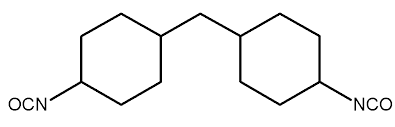
TPU from HDI and H12MDI

Patent Title: NON-SOFTENING RESILIENT THERMOPLASTIC POLYURETHANES

 Number/Link: WO2016/054320

Applicant/Assignee: Lubrizol

Publication date: 7-04-1016

Gist”: TPU from a blend of HDI and H12MDI has improved creep and wet modulus

Why it is interesting: Polymeric materials used for in vivo medical applications like catheters, need to be hydrolytically stable and retain physical properties like stiffness, resilience, flexibility etc. in wet conditions.  It is known that conventional TPUs based on aromatic or cyclo-aliphatic isocyanates tend to show some softening in aqueous environments. For this reason copolyamides (COPAs) and polyether-block-polyamides (PEBAs) are often preferred over TPU for use in medical devices.  According to this invention, TPUs that can replace COPA and PEBA in medical applications can be produced using a blend of 1,6-hexanediisocyanate (HDA) and H12MDI. In the examples polyether TPUs, prepared from 2000MW polytetramethyleneether diol, butanediol and a 19:1 HDI:H12MDI isocyanate blend at harblock contents ranging from 15 to 50%, convincingly show improved creep properties and wet modulus when compared to conventional TPU and a commercial PEBA material.

H12MDI

H12MDI

  • Pages

  • Categories

  • Enter your email address to follow this blog and receive notifications of new posts by email.

    Join 259 other subscribers
  • Follow Innovation in PU on Twitter