Sound Absorbing PU-PA Foams

Title: THERMOFORMABLE RIGID POLYURETHANE-POLYAMIDE FOAM

 Number/Link: US2014/058005

Applicant/Assignee: BASF

Publication date: 27-2-2014

Gist”: Rigid, open-celled and thermoformable polyurethane-polyamide foams are produced using short chain di-acids as both chain extender and blowing agent.

Why it is interesting: The reaction of a carboxylic acid group with an isocyanate group results in a mixed anhydride, which after releasing carbon dioxide forms an amide. Because the reaction is relatively sluggish a  Lewis base catalyst is used, e.g. N-methylimidazole. In this case a rigid foam-forming formulation based on MDI and (pref.) polyether polyols is further reacted with short chain diacids like azelaic- or glutaric acid.  The examples show foam densities of less than 30 kg/m³ without the use of water.  The foams are open celled with high air flow and with a Tg of around 90°C, making them thermoformable.  This type of foams is used as acoustic bonnet- en roofliners in the automotive industry.

Azelaic Acid
Azelaic Acid

Nanocomposites from PIB-Based Polyurethane and Clay

Title: POLYISOBUTYLENE-BASED POLYURETHANES CONTAINING ORGANICALLY MODIFIED MONTMORILLONITE

 Number/Link: WO/2014/018509

Applicant/Assignee: UNIVERSITY OF AKRON

Publication date: 30-01-2014

Gist”: A small amount of montmorillonite, modified with a quaternary ammonium compound containing an amine group, is incorporated in a polyisobutylene-based TPU.

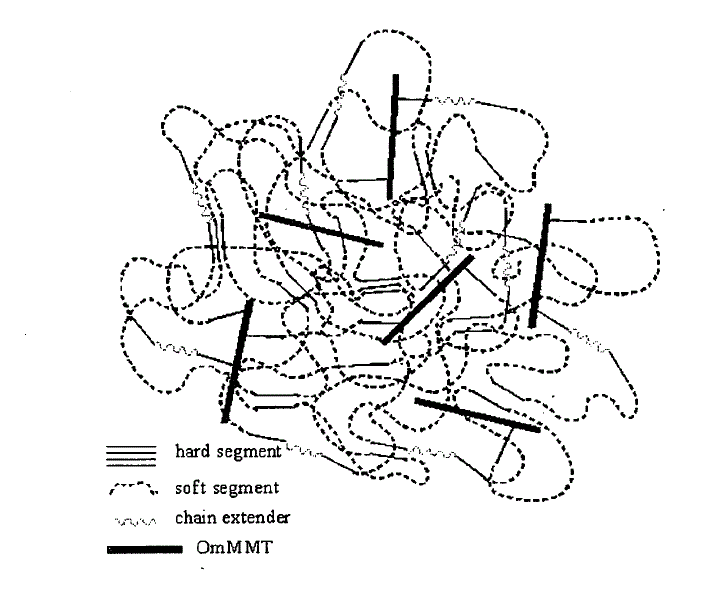
Why it is interesting: Montmorillonite-type clay is “exfoliated” using a quat. ammonium compound which has an alkyl subsituent containing a primary amine group. The salt group will electrostatically interact with the clay while the amine group will react with isocyanate when used in a polyurethane formulation, thus incorporating the clay into the polymer structure. In an example a (T)PU is made from HMDI, 1,6-hexanediol and a mixture of a 4000MW polyisobutylene diol and a 1000MW PTMO diol. A montmorillonite was exfoliated using trimethyl-1-propylamine ammonium iodide (I¯N+(CH3)3CH2CH2CH2-NH2)  and incorporated in the PU to make the nanocomposite. In an amount of 0.5% (w/w) the clay increases stiffness, mechanical- and creep properties of the PU.  However at higher amounts (2%,5%..) these properties actually deteriorate.

Polymer morphology model according to the invention.  (omMMT = organically modified montmorrilonite)

Polymer morphology model according to the invention. (omMMT = organically modified montmorillonite)

Self-Cleaning Coating… or not?

Title: SELF-RENEWING HYDROPHILIC ORGANIC COATINGS

 Number/Link: US2014/018466

Applicant/Assignee: Empire Technology

Publication date: 16-01-2014

Gist”: Coating containing free amine groups resulting in a hydrophilic surface that is supposedly self-cleaning.

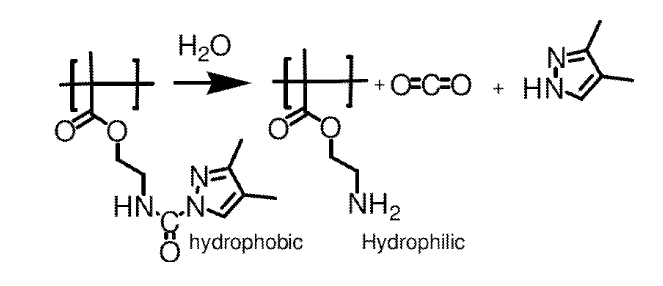
Why it is interesting: Conventionally “self-cleaning” surfaces are produced using hydrophobic coating compositions resulting in surfaces with low contact angles with respect to water.  The current case claims that highly hydrophilic surfaces also show a self-cleaning effect.  An emulsion-polymerized polymer with blocked-isocyanate side groups is used as a coating composition.  After the coating is applied the side groups are deblocked by atmospheric moisture resulting in (hydrophilic) amine groups.  In an example 2-methyl-acrylic acid 2-isocyanatoethyl ester blocked with 3,5-dimethylpyrazole was emulsion polymerized and, together with additives, used as a coating composition.
While this is fun chemistry I very much doubt that this coating would be truly self-cleaning.  The amine groups will surely react with all kinds of stuff in the air possibly resulting in quite the opposite.

deblocking of the isocyanate side groups under the influence of water.

deblocking of the isocyanate side groups under the influence of water.

  • Pages

  • Categories

  • Enter your email address to follow this blog and receive notifications of new posts by email.

    Join 259 other subscribers
  • Follow Innovation in PU on Twitter