Polyurethane Elastomers containing Polyrotaxanes

Title: CAST-MOLDED HEAT-CURABLE POLYURETHANE ELASTOMER

 Number/Link:  WO2015/159875  (Japanese)

Applicant/Assignee: UBE

Publication date: 22-10-2015

Gist”: 1-10% of a polyrotaxane is incorporated in a hot cast PU elastomer system

Why it is interesting: Polyrotaxanes are molecular systems consisting of a linear polymer which is “threated” through a number of ring-shaped molecules. The rings are prevented from ‘sliding off’ by blocking-molecules at both ends of the “thread”. In this invention polyrotaxanes based on a polycaprolactone thread and cyclodextrin rings (pref.) are incorporated in hot cast elastomer systems in amounts of 1-10% (w/w). Because cyclodextrin rings contain hydroxyl groups they react with the isocyanate incorporating the polyrotaxane in the PU polymer. The systems are said to have processing and property advantages for specific elastomer applications, in this case printer rollers – if I understand the machine translation correctly.

Schematic presentation of a polyrotaxane
Schematic presentation of a polyrotaxane

TPU from POM-Polyether Polyols

Title: THERMOPLASTIC POLYURETHANES, PRODUCTION AND USE THEREOF

 Number/Link: WO2015/155084  (German)

Applicant/Assignee: Bayer

Publication date: 15-10-2015

Gist”: Paraformaldehyde-PO polyols are used to make TPU

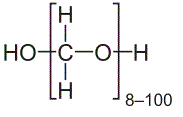
Why it is interesting: Polyoxymethylene (POM) is a highly crystalline ‘engineering thermoplastic’ often used in blends together with TPU. In this invention POM is not blended but used to make a POM-polyether ‘block’ diol which is then used to make TPU. The diol is prepared by using paraformaldehyde as a starter which is reacted with PO (and optionally CO2) using DMC catalysis. The POM-block acts as a ‘hard block’ and use of the diol allows for an improved control of Tg, melt viscosity, hardness, chemical resistance etc. of the TPU.  In the examples TPU is made from a 2000 MW parafomaldehyde/PO-CO2 block copolymer  together with 4,4’MDI and BDO.

Paraformaldehyde

Paraformaldehyde

PLA-PPG-PU Block Copolymers

Title: LACTIDE COPOLYMER, METHOD FOR PREPARING SAME, AND RESIN COMPOSITION COMPRISING SAME

 Number/Link:US2015/0284516

Applicant/Assignee: LG Chem

Publication date: 8-10-2015 (Priority PCT/KR)

Gist”: Polyether-polylactide block copolymers are prepared using ROP and then extended with isocyanates

Why it is interesting: Polylactic acid (PLA) is a well known renewable and biodegradable polymer often used in the form of films or sheets for disposable packaging. The polymer is however not very flexible and the films have poor mechanical properties. According to this invention both flexibility and mechanical properties can be greatly improved by making polyether-polylactide copolymers and then extending these using an isocyanate with a functionality of more than 2. The copolymers are made by ring-opening polymerization of lactide monomer using a polyether diol as a ‘macro’ initiator together with a specific catalyst. In the examples an excess L-lactide monomer is used which is reacted with a 4000 to 6000 mole weight polypropylene glycol, resulting in a block copolymer with a Mw of more than 100,000.  The block copolymer is then reacted with a mixture of MDI and hexamethylenediisocyanate isocyanurate, after which the residual lactide is removed.

L-Lactide

L-Lactide

  • Pages

  • Categories

  • Enter your email address to follow this blog and receive notifications of new posts by email.

    Join 259 other subscribers
  • Follow Innovation in PU on Twitter