Novel Aliphatic Polyester Polyols for TPU

Patent Title: POLYESTER POLYOLS AND POLYURETHANES

 Number/Link: WO2015/185744

Applicant/Assignee: DSM

Publication date: 10-12-2015

Gist”: Polyester polyols from succinic- and sebacic acid mixtures

Why it is interesting: Aliphatic polyester polyols used in polyurethane elastomers, are usually based on adipic acid and diols like MEG, DEG, butanediol or mixtures of these. Since recently, succinic acid has become a commercially avaible renewable compound and it makes sense to use it in polyester polyol production. Replacing adipic acid by succinic acid however, results in polyesters with a reduced hydrolysis resistance (at the same polyol molecular weight).  According to this invention this can be solved by using blends of succinic acid with C8 to C36  diacids, most preferably with sebacic (C10) acid.
Not a spectacular innovation and probably not as such patentable but a solid, useful idea.
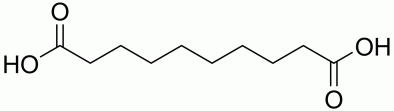
Sebacic acid
Sebacic acid

TPU from Asymmetric Chain Extenders

Patent Title: THERMOPLASTIC POLYURETHANE

 Number/Link: WO2015/173337

Applicant/Assignee: Henkel

Publication date: 19-11-2015

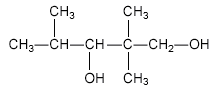
Gist”: TPU is made using diols with 1 prim- and one sec-OH group

Why it is interesting: Thermoplastic polyurethanes (TPU) have many desirable properties but are notoriously difficult to process: they need a high processing temperature (>160°C ) and have a high melt viscosity requiring high shear processing equipment. According to the current invention the melt viscosity can be greatly reduced by using an asymmetric diol as chain extender (i.e. with one pimary and one secondary hydroxyl group) instead of a conventional symmetric diol. In the examples polyester-MDI TPUs extended with asymmetric diols (e.g. 1,3-butanediol or 2,2,4-trimethyl-1,3-pentanediol)  are shown to have a much lower melt viscosity compared to TPU extended with 1,4-butanediol. These TPUs are especially useful as hotmelt adhesives.

2,2,4,-trimethyl-1,3-pentanediol

2,2,4,-trimethyl-1,3-pentanediol

Classic PU Patent of the Month: Non-Isocyanate Polyhydroxyurethanes by Dow (1957)

Title: Polyhydroxyurethanes

 Number/Link: US3084140

Applicant/Assignee: Dow

Publication date: 2-04-1963

Gist”: bis-cyclocarbonates are reacted with aliphatic polyamines

Why it is interesting: Non-isocyanate polyurethanes (NIPU) are still gaining in popularity – at least in the patent and science literature. The chemistries to make NIPU are far from new as discussed in a previous ‘classic patent of the month’ on this blog.  The most common route to NIPU is by reacting cyclocarbonates with amines resulting in hydroxyurethanes, as was first dicussed in this patent. The intent of the invention was, actually, not to avoid the use of isocyanates but to make hydroxy-group containing polyurethanes which were said to be ‘highly desirable’:  the OH groups can act as points for crosslinking, make the resin more hydrophilic and compatible with certain materials etc.

Preparation of polyhydroxyurethanes according to the invention

Preparation of polyhydroxyurethanes according to the invention

  • Pages

  • Categories

  • Enter your email address to follow this blog and receive notifications of new posts by email.

    Join 259 other subscribers
  • Follow Innovation in PU on Twitter