Reactive Polyurethane Plasticizer

Patent Title: REACTIVE POLYURETHANE PLASTICIZERS AND ADHESIVES MADE THEREFROM

 Number/Link: W02016179131

Applicant/Assignee: Dow

Publication date: 10-11-2016

Gist”: An EO/PO monol is reacted with an excess of 4,4′-MDI

Why it is interesting: The invention is about reactive PU plasticizers which are said to be especially useful for polyurethane moisture curing adhesives used in automotive glass bonding. As opposed to conventional plasticizers they will supposedly not migrate and therefore not degrade adhesive properties over time or cause window fogging. The reactive plasticizers are prepared by reacting a slight excess of 4,4′-MDI with and EO/PO monol of MW between 500 and 2000 Da and an EO:PO ratio of about 1:1, such that the resulting in NCO content is between 0.1 and 1%.  Obviously at such low NCO values most of the MDI will have reacted twice with monol, and the resulting non-reactive plasticizer may (in my opinion) well migrate depending on the composition of both monol and adhesive.

4,4'-MDI

4,4′-MDI


Classic PU Patent of the Month: Microencapsulation (1963)

Patent Title: ENCAPSULATION BY INTERFACIAL POLYCONDENSATION

 Number/Link:  US3577515

Applicant/Assignee: Pennwalt Corp.

Publication date: 4-05-1971

Gist”: Interfacial polycondensation on the surface of emulsified droplets.

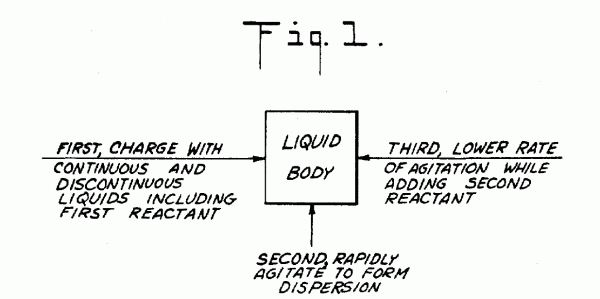
Why it is interesting: Micro-sized droplets are encapsulated with a polymeric film or ‘skin’ formed by an interfacial polycondensation reaction. The idea is both very clever and simple: one reaction component is dissolved in a liquid which is then dispersed in another -immiscible- liquid. The second reaction component is then added to the continuous phase resulting in a polycondensation reaction at the surface of the droplets, encapsulating these with a polymeric film. For example a solution of a polyisocyanates in an organic solvent can be dispersed in water (to a desired droplet size) after which a water soluble diol or diamine is added resulting in a polyurethane or polyurea film encapsulating the solvent droplets. Microcapsules are now common and used in may applications like cosmetics, phase change materials, e-paper, self-healing coatings etc.

Figure 1 illustrating the process

Figure illustrating the process

Non-Isocyanate Polyurethanes from Sucrose-Fatty Acid Esters

Patent Title: BIOBASED CYCLIC CARBONATE FUNCTIONAL RESINS AND POLYURETHANE THERMOSETS THEREFROM

 Number/Link: US2016/0312060

Applicant/Assignee: NDSU

Publication date: 27-10-2016

Gist”: Epoxidized sucrose-fatty acid esters are reacted with CO2, then with polyamines

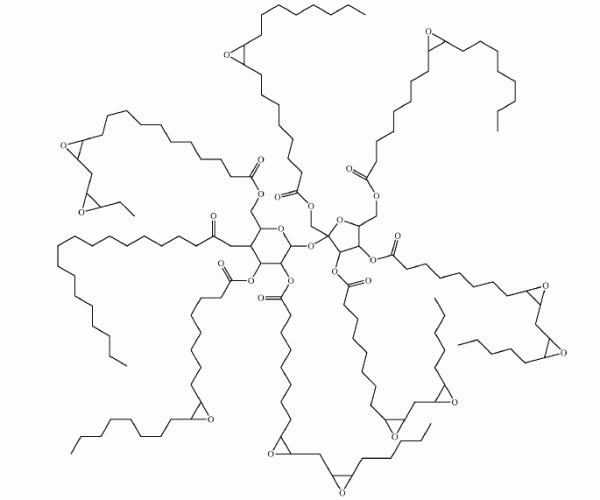
Why it is interesting:  Esters of unsaturated fatty acids and sucrose have been known since the 1960s and are useful in e.g. coatings.  Highly subsituted sucrose esters with an average of 7.7 fatty acid chains per molecule, a molecular weight of about 2400 and a relatively low viscosity of 300-400 mPa.s are commercially available. According to this invention, epoxidized sucrose-fatty acid esters can be further reacted with carbon dioxide resulting in a resin with a ‘pluraility’ of cyclocarbonate groups. Curing with polyamines results in highly crosslinked poly(hydroxyurethanes) useful for coatings, composites and adhesives.

Epoxidized sucrose-fatty acid ester

Epoxidized sucrose-fatty acid ester


  • Pages

  • Categories

  • Enter your email address to follow this blog and receive notifications of new posts by email.

    Join 259 other subscribers
  • Follow Innovation in PU on Twitter