Renewable Polyols from “Distillers Grains”

Title: PRODUCTION OF POLYOLS USING DISTILLERS GRAINS AND PROTEINS AND LIGNIN EXTRACTED FROM DISTILLERS GRAINS

 Number/Link: US2014/200324

Applicant/Assignee: EMGPI PROC and PITTSBURG STATE UNIVERSITY 

Publication date: 17-07-2014

Gist”: Dried distillers grains are transamidated and then alkoxylated to form a polyol useful for rigid polyurethane spray foams.

Why it is interesting: ‘Distillers grains’ are a by-product of ethanol production and are currently avaible in huge quatities due to the state-sponsored bio-ethanol production in the US.  Most of the product is used as animal feeds because of the high levels of nutrients. Dried distillers grain (DDGS) contains about 30% protein, about 30% fibers (cellulose, hemicellulose and lignin) and about 30% lipids, ash and water. According to this invention DDGS can be turned into polyols by first reacting the (solid) DDGS with diethanolamine at elevated temperature and pressure (about 200°C and 3.5 MPa) and breaking down the proteins in amino-amides. The resulting liquid can subsequentlly be epoxidized with propylene oxide resulting in a polyol which is supposedly highly reactive and useful for polyurethane rigid spray foams.
Personally I find it hard to believe that a decent reproducible foam can be made with such a horrible mixture.
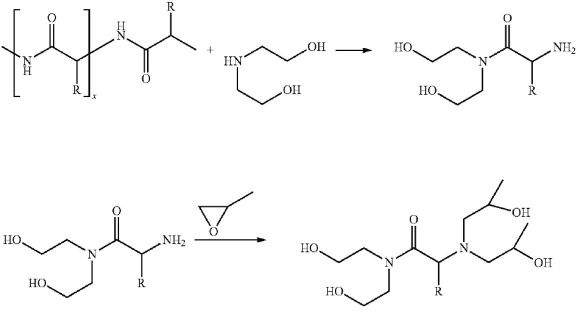
Transamidation of protein with subsequent epoxidation.

Transamidation of protein with subsequent epoxidation.

Classic PU Patent of the Month: The First SMPUs (1988)

Title: Shape memory polymer foam.  – and – Shape memory polyurethane elastomer molded article.

 Number/Link: EP0361418 and EP0361419

Applicant/Assignee: Mitsubishi Heavy Industries

Publication date: 27-09-1989

Gist”: The first shape memory polyurethane foams and elastomers

Why it is interesting: Shape memory polymers are so-called “smart materials” that remain in a deformed shape until a trigger (usually an increase in temperature) makes them return to their original  (“memorized”) shape. In the 1980s these materials were more of a curiosity, only used in some niche applications such as heat shrinkable tubing. Currently however a lot of academic and industrial research is done on these materials, mostly driven by medical applications (e.g. stents, orthopedic casts, self-tightening sutures etc). And not surprisingly a lot of current SMPs are based on polyurethanes (SMPUs).  Interest in shape memory materials was stimulated significantly by the invention of the first SMPUs by Mitsubishi H.I. Ltd. They filed two patents covering both shape memory foams and elastomers. The first SMPUs were based on a di-isocyanate like 4,4′-MDI, a diol like PPG700 and a chain extender like bisphenol-A, and were formulated over a range of Tg’s. The foamed materials were blown with a physical blowing agent (i.e. not water) so that all materials can be considered thermoplastics.

SMP transition from temporary shape (spiral) to permanent shape (rod).  (Angew. Chem. Int. Ed. 2002, 41, 2034 ± 2057)

SMP transition from temporary shape (spiral) to permanent shape (rod). (Angew. Chem. Int. Ed. 2002, 41, 2034 ± 2057)

Improved “Black” Insulation Foams

Title: ISOCYANATE-BASED POLYMER FOAM COMPOSITE WITH IMPROVED THERMAL INSULATION PROPERTIES

 Number/Link: US20140151593

Applicant/Assignee: Dow

Publication date: 5-06-2014 (Priority PCT/US)

Gist”: Use of fluorinated carbon black to improve insulation value of rigid polyurethane foams

Why it is interesting: It is known that carbon black can be used to improve the insulation value of rigid foams by reducing the radiation component of the thermal conductivity. The carbon black however needs to have a very small particle size and needs to be extremely well dispersed into the reacting medium. According to the invention using a fluorinated carbon black improves the dispersion into the raw materials which, in turn, improves the final insulation value of the foam.
A small but valuable innovation.

Different grades of carbon black

Different grades of carbon black

  • Pages

  • Categories

  • Enter your email address to follow this blog and receive notifications of new posts by email.

    Join 259 other subscribers
  • Follow Innovation in PU on Twitter