TPU from POM-Polyether Polyols

Title: THERMOPLASTIC POLYURETHANES, PRODUCTION AND USE THEREOF

 Number/Link: WO2015/155084  (German)

Applicant/Assignee: Bayer

Publication date: 15-10-2015

Gist”: Paraformaldehyde-PO polyols are used to make TPU

Why it is interesting: Polyoxymethylene (POM) is a highly crystalline ‘engineering thermoplastic’ often used in blends together with TPU. In this invention POM is not blended but used to make a POM-polyether ‘block’ diol which is then used to make TPU. The diol is prepared by using paraformaldehyde as a starter which is reacted with PO (and optionally CO2) using DMC catalysis. The POM-block acts as a ‘hard block’ and use of the diol allows for an improved control of Tg, melt viscosity, hardness, chemical resistance etc. of the TPU.  In the examples TPU is made from a 2000 MW parafomaldehyde/PO-CO2 block copolymer  together with 4,4’MDI and BDO.
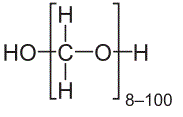
Paraformaldehyde
Paraformaldehyde

Modified Polyols for Improved PU Adhesives

Title: POLYOL COMPOSITIONS FOR HOT MELT ADHESIVES

 Number/Link:WO2015/127276

Applicant/Assignee: IFS Industries

Publication date: 27-08-2015

Gist”: Polyester diols are partially capped with bulky glycidyl esters

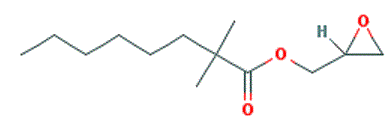
Why it is interesting: According to this invention polyester (or polyether) polyols which are partially capped with a bulky glycidyl ester can be used to improve the adhesive properties of (reactive) polyurethane (hotmelt) adhesives. Specifically the adhesion to materials with low surface energies like ABS or polyolefines is said to improve. In the examples polyester diols prepared from adipic acid and hexanediol with a Mn of about 3000 are partially capped with the glycidyl ester of neodecanoic acid (“Versatic Acid 10”) and used in PU adhesive formulations.

Glycidyl ester of neodecanoic acid

Glycidyl ester of neodecanoic acid

PU Rigid Foams from Biomass Proteins

Title: POLYOLS FROM BIOMASS AND POLYMERIC PRODUCTS PRODUCED THEREFROM

 Number/Link:WO2015/105542

Applicant/Assignee:  Inventors

Publication date: 16-07-2015

Gist”: Soy bean proteins are hydrolysed and reacted with diamines and cylocarbonates to produce “rigid” polyols.

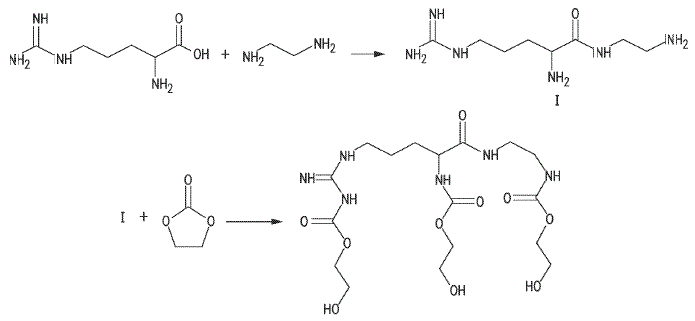
Why it is interesting: During recent years a lot of research has been done on the use of renewable raw materials in polyurethanes.  Most of this research was on the use of natural oils despite the fact that the availability of biomass proteins is much higher. Soybeans for example contain about twice as much protein (about 38% w/w) than oil (18%) and the price is about half that of the oil. According to this invention soybean proteins are hydrolysed into amino acids which are then reacted with ethylene diamine to make amine-ended monomers.  These monomers are reacted with a cyclocarbonate (ethylene carbonate or glycerol carbonate) resulting in a mixture of hydroxyurethane oligomers. The mixture is a low viscous liquid with high hydroxyl value useful for the production of rigid foams.

Reaction sequence according to the invention

Reaction sequence according to the invention

  • Pages

  • Categories

  • Enter your email address to follow this blog and receive notifications of new posts by email.

    Join 259 other subscribers
  • Follow Innovation in PU on Twitter