Aerogels from Urethane-Acrylate Star Monomers

Title: FLEXIBLE TO RIGID NANOPOROUS POLYURETHANE-ACRYLATE (PUAC) TYPE MATERIALS FOR STRUCTURAL AND THERMAL INSULATION APPLICATIONS

 Number/Link:US2015/0266983

Applicant/Assignee: University of Missouri

Publication date: 24-09-2015

Gist”: A trifunctional acrylate-ended urethane monomer is polymerized in solvent and supercritically dried

Why it is interesting: Research related to nanoporous materials has been gaining significant momentum in recent years and both inorganic (usually silica-based) and organic (e.g resorcinol-formaldehyde or polyurethane -based) aerogels are increasingly being used especially for thermal insulation applications. The current invention relates to hybrid PU-AC aerogels prepared from acrylate functional “star” monomers. The monomers are made by reacting a tris(isocyanatoaryl)methane with one or more hydroxyacrylates in a suitable solvent.  The monomer is then radically polymerized and the resulting ‘wet’ gel is supercritically dried into an aerogel. In the examples tris(4-isocyanatophenyl)methane is reacted with 2-hydroxyethylacrylate in ethyl acetate. The monomer solution is polymerized by heating with a radical initiator and the resulting gel is then dried using acetone and supercritical CO2.  The resulting aerogels have a density ranging from about 135 to 650 kg/m³ with a porosity bewteen 90 and 50% (v/v).  The lower density aerogels are flexible and have a thermal conductivity of about 40 mW/m.K.
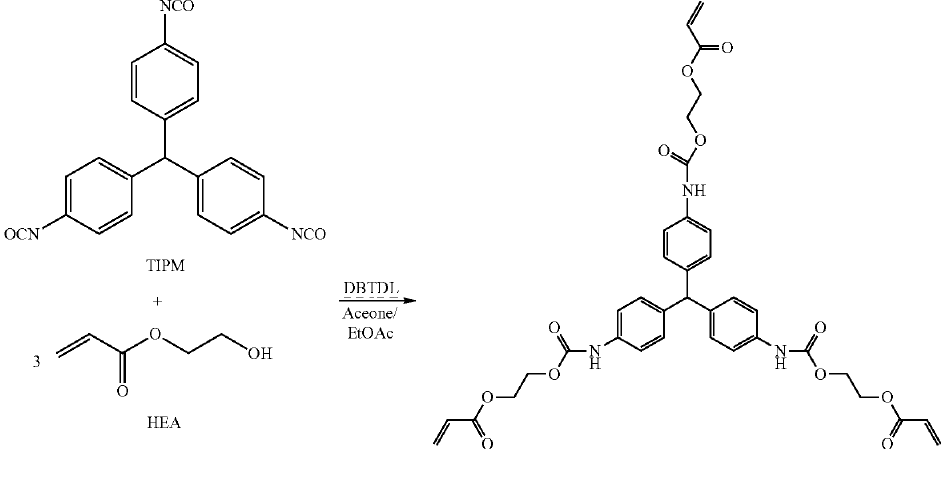
Star monomer according to the invention
Star monomer according to the invention

Classic PU patent of the Month: PORON ® Foams (1979)

Title: Polyurethane foam product and process of manufacture thereof from thermosetting frothed mixture

 Number/Link: US4216177

Applicant/Assignee: Rogers

Publication date: 5-08-1980

Gist”: Frothed flexible foam

Why it is interesting: PORON is a popular brand of microcellular elastomeric/flexible polyurethane foams produced by Rogers Corporation. The original process, as documented in this patent, is quite simple:  a flexible foam formulation (in the examples) based on TDI, caprolacton diol, polymer polyol, some chain extender, amine catalyst and surfactant is frothed instead of blown with water or a physical blowing agent. The reacting froth is poured on release paper and heated to cure. Release paper can also be applied on top resulting in an integral skin on both sides of the layer. Frothing instead of blowing results in an improved compression set, different hardness-density relationship and a better control over cell structure. A unique material.

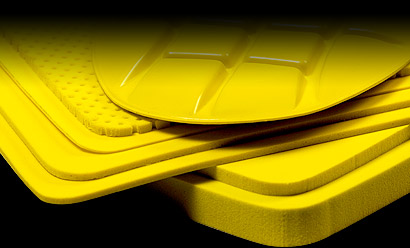
PORON foams

PORON foams

Flexible Foams with Improved Thermal Comfort

Title: IN-SITU GELATINOUS TRIBLOCK COPOLYMER ELASTOMERS IN POLYURETHANE FLEXIBLE FOAMS

 Number/Link:US2015/0166756

Applicant/Assignee: Peterson Chemical Technology

Publication date: 18-06-2015

Gist”: Gelatinous styrenic block copolymers are incorporated in flexible foams to increase thermal conductivity.

Why it is interesting: High viscosity styrenic triblock copolymer resins (like SBS, SEBS, SIS etc), plasticized with mineral oils, are added to flexible foam-forming compositions. The heat of the foam-forming reaction is said to be sufficient to further polymerize the resins and melt the styrene-block such that the block copolymers get integrated into the polyurethane matrix. The resulting foams show increased load bearing and improved thermal conductivity. These systems could improve the thermal comfort properties of cushioning materials, especially those of viscoelastic foams.

Poly(styrene-butadiene-styrene) or SBS.

Poly(styrene-butadiene-styrene) or SBS.

  • Pages

  • Categories

  • Enter your email address to follow this blog and receive notifications of new posts by email.

    Join 259 other subscribers
  • Follow Innovation in PU on Twitter