TPU/PU-Acrylate Semi-IPNs

Patent Title: THERMALLY STABLE MICROSTRUCTURED SEMI-IPN LAYER

 Number/Link: WO2016/191118

Applicant/Assignee: 3M

Publication date: 1-dec-2016

Gist”:  TPU and PU-acrylate oligomers are blended and radiation-cured

Why it is interesting: According to this invention semi-interpenetrating polymer networks (IPNs) that are prepared from thermoplastic polyurethane (or urethane/urea) and acrylate-functional polyurethane oligomers are highly heat-stable and abrasion resistant and can be used for the production of microstructured surfaces.  Microstructured (‘riblet’) surfaces with dimples or ridges of a few to a few hundred microns deep are used as drag reducing coatings on planes, ships and in aeronautics. In the examples 90% of a commercial TPU is blended and co-extruded with 10% of a commercial aliphatic urethane acrylate oligomer.  The extruded film was then laminated on on a microreplicated liner, radiation cured and removed from the liner to produce the riblet surface.
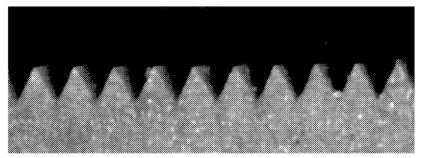
Microstructured layer according to the invention

Microstructured layer according to the invention

Self-Healing Polyurethane Elastomers

Patent Title: POLYURETHANE

 Number/Link: W02016185172

Applicant/Assignee: Croda

Publication date: 24-11-2016

Gist”: PU from polyols which contain both a fatty dimer residue and an H-bonding group, show self-healing properties

Why it is interesting: Polyurethane elastomers with ‘intrinsic’ self-healing properties (i.e. without the need for external chemicals like encapsulated monomers) can be prepared by reacting isocyanates with polyols that have at least one urethane, amide or carbonate group and at least one fatty dimer residue. It is theorized that the fatty dimer allows the soft-phase of the polymer to flow and H-bonds to form, thus restoring most of the properties after damage.  In the examples polyols with internal urethane groups were prepared by reacting C36 dimer diol with HDI, which were then reacted with MDI and BDO. Samples of the resulting elastomers were cut in half, and manually stuck together again under mild heating (60°C), thus recovering most of their tensile and elongation properties.

A dimer diol

A dimer diol

PU-Acrylate/Epoxy IPN for 3D Printing

Patent Title: PHOTOCURABLE COMPOSITIONS FOR THREE-DIMENSIONAL PRINTING

 Number/Link:  WO 2016/153711

Applicant/Assignee: Dow

Publication date: 29-09-2016

Gist”: Acrylate-capped PU prepolymer is copolymerized with epoxides using UV radiation

Why it is interesting: This case is about UV-curable compositions to make flexible materials using additive manufacturing, especially stereolithography.  A prepolymer of an isocyanate and a ‘flexible’ polyol is capped with a hydroxy-functional acrylate, then mixed with a multifunctional epoxy, a multifunctional acrylate ‘monomer’ (a crosslinker also acting as reactive diluent) and two photoinitiators:  one radical and one cationic.  In the example a 6 to 8000 Mole weight diol is capped with TDI and then with hydroxyethyl acrylate.  The prepolymer is then mixed with 3,4-Epoxycyclohexylmethyl-3,4-epoxycyclohexane carboxylate, 1,6-hexanedioldiacrylate and two photoinitiators.  After UV curing the materials had a shore A hardness between about 60 and 80 and an elongation at break between about 70 and 200.

3,4-Epoxycyclohexylmethyl-3,4- epoxycyclohexane carboxylate

3,4-Epoxycyclohexylmethyl-3,4-
epoxycyclohexane carboxylate

  • Pages

  • Categories

  • Enter your email address to follow this blog and receive notifications of new posts by email.

    Join 259 other subscribers
  • Follow Innovation in PU on Twitter