Classic PU patent of the Month: PORON ® Foams (1979)

Title: Polyurethane foam product and process of manufacture thereof from thermosetting frothed mixture

 Number/Link: US4216177

Applicant/Assignee: Rogers

Publication date: 5-08-1980

Gist”: Frothed flexible foam

Why it is interesting: PORON is a popular brand of microcellular elastomeric/flexible polyurethane foams produced by Rogers Corporation. The original process, as documented in this patent, is quite simple:  a flexible foam formulation (in the examples) based on TDI, caprolacton diol, polymer polyol, some chain extender, amine catalyst and surfactant is frothed instead of blown with water or a physical blowing agent. The reacting froth is poured on release paper and heated to cure. Release paper can also be applied on top resulting in an integral skin on both sides of the layer. Frothing instead of blowing results in an improved compression set, different hardness-density relationship and a better control over cell structure. A unique material.
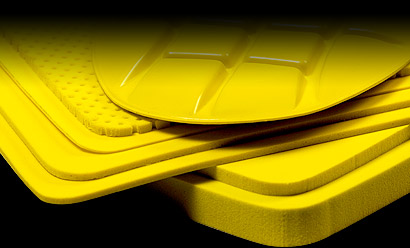
PORON foams
PORON foams

Polyurethane-Polyamides from Dimer Diacids

Title: A POLYOL BASED ON DIMER FATTY ACID RESIDUES AND THE CORRESPONDING POLYURETHANES

 Number/Link:WO2015/097433

Applicant/Assignee: Croda

Publication date: 2-07-2015

Gist”: Polyurethane/polyamide elastomers based on dimer diacids and long chain dicarboxylic acids

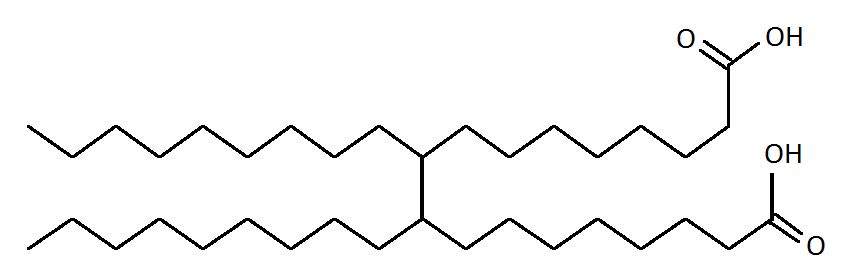
Why it is interesting: Polyurethane elastomers (and thermoplastic elastomers) based on dimer diacids or dimer diols are very hydrophobic and hydrolysis resistant but are relatively soft with lowish mechanical properties. According to this invention, using a blend of a dimer diacid (or -diol) and a (semi-) crystalline C17 to C32 dicarboxilic acid (or -diol) results in elastomers with greatly improved hardness and tensile strength while retaining flexibility and hydrolysis resistance. The C17 to C32 dicarboxylic acids can be prepared by a self-metathesis reaction of unsaturated fatty acid esters.  In the examples a C36 dimer diacid is used together with 1,18-octadodecanoic acid (prepared by metathesis from methyl oleate).  This is reacted ‘one shot’ with 4,4′ MDI and hexanediol or DEG, resulting in 85 shore A elastomers with high elongation and hydrolysis resistance.

A C36 dimer diacid

A C36 dimer diacid

Polyurethanes with Reduced Aldehyde Emissions

Title: POLYURETHANES HAVING REDUCED ALDEHYDE EMISSION

 Number/Link:WO2015/082316 (German)

Applicant/Assignee: BASF

Publication date: 11-06-2015

Gist”: Use of CH-acidic compounds as aldehyde scavengers

Why it is interesting: Reducing VOC emissions, and especially aldehyde emissions, from polyurethane systems remains an important research topic and has been discussed before on this blog (see e.g.  here and here). To reduce aldehyde emissions, scavenger molecules are used which are often amines or hydrazine compounds.  In this invention however the aldehyde scavenger is a CH-acidic compound of the form R-CH2-R’ in which R and R’ are electron-withdrawing groups. The R-groups can be iso-reactive and the molecule can (preferably) contain more than one acidic CH2 group, like e.g. trimethylolpropane triacetoacetate. Other examples are N,N-dimethylacetoacetamide and dimethyl 1,3-acetonedicarboxylate. The compounds are used in an amount of 0.5 to 1 pphp, are said to have advantages over the prior art like less or no catalytic activity and do not lead to extra emissions.

Trimethylolpropane triacetoacetate

Trimethylolpropane triacetoacetate

  • Pages

  • Categories

  • Enter your email address to follow this blog and receive notifications of new posts by email.

    Join 259 other subscribers
  • Follow Innovation in PU on Twitter