Novel Polyurethane Gels

Patent Title: POLYURETHANE BASED GEL COMPOSITION

 Number/Link: W016/036786

Applicant/Assignee: Dow

Publication date: 10-03-2016

Gist”: PU gels are made from MDI prepolymer, high EO polyol and some diamine at low NCO index.

Why it is interesting: Polyurethane gels are well known and are sometimes used in comfort cushioning as layers or dispersed as particles in e.g. viscoelastic matresses. According to this invention plasticizer-free gels can be made by reacting a slightly branched, low NCO prepolymer ( based on 2,4′ and 4,4′ MDI and a high EO polyol), with a large amount of high EO polyol (triol or higher) and some amine-ended low mole-weight diol.
Although the material is said to be ‘plasticizer-free’not all of the polyol will be reacted at low NCO index.  However, because of its high polarity, the unreacted polyol will probably not leach.
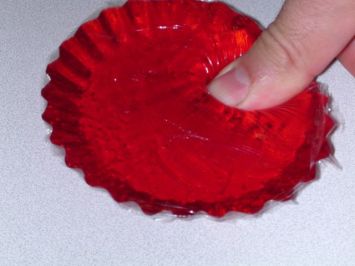
A Polyurethane Gel

A Polyurethane Gel

Flexible PU Foam with Very Low Resilience

Patent Title: LOW-RESILIENCE POLYURETHANE FOAM AND PRODUCTION METHOD THEREOF

 Number/Link: US2016/0024268

Applicant/Assignee: Mitsui

Publication date: 28-01-2016

Gist”: Use of trans-BIC in viscoelastic flex foam

Why it is interesting: According to this invention low resilience flexible foams can be produced by reacting a mixture of two (optionally three) polyether polyols, water, a crosslinker and a catalyst with 1,4-bis(isocyanatomethyl)cyclohexane (BIC) where the BIC consists of (pref) 90% or more of the trans isomer. Higher trans-isomer is said to result in higher airflow and a finer cellstructure. In the examples a high MW all-PO triol and a low MW EO/PO triol with 18% EO tip is used, together with BIC at an NCO index of 70%.  The resulting foams have a high airflow and a (very) low resilience at densities between 50 and 70 kg/m³. While trans-BIC is clearly an interesting aliphatic di-iso, it is not widely available.

trans-1,4-bis(isocyanatomethyl)cyclohexane

trans-1,4-bis(isocyanatomethyl)cyclohexane

Flexible Foams with Improved Thermal Comfort

Title: IN-SITU GELATINOUS TRIBLOCK COPOLYMER ELASTOMERS IN POLYURETHANE FLEXIBLE FOAMS

 Number/Link:US2015/0166756

Applicant/Assignee: Peterson Chemical Technology

Publication date: 18-06-2015

Gist”: Gelatinous styrenic block copolymers are incorporated in flexible foams to increase thermal conductivity.

Why it is interesting: High viscosity styrenic triblock copolymer resins (like SBS, SEBS, SIS etc), plasticized with mineral oils, are added to flexible foam-forming compositions. The heat of the foam-forming reaction is said to be sufficient to further polymerize the resins and melt the styrene-block such that the block copolymers get integrated into the polyurethane matrix. The resulting foams show increased load bearing and improved thermal conductivity. These systems could improve the thermal comfort properties of cushioning materials, especially those of viscoelastic foams.

Poly(styrene-butadiene-styrene) or SBS.

Poly(styrene-butadiene-styrene) or SBS.

  • Pages

  • Categories

  • Enter your email address to follow this blog and receive notifications of new posts by email.

    Join 259 other subscribers
  • Follow Innovation in PU on Twitter