Bio-Renewable Thermoplastic Polyurethanes

Title: HOMOGENEOUS EXTRUDED ARTICLES MADE FROM THERMOPLASTICALLY PROCESSABLE POLYURETHANES BASED ON POLYESTER DIOLS FORMED FROM SUCCINIC ACID AND 1,3-PROPANEDIOL

 Number/Link: US2014/0256902

Applicant/Assignee: Bayer

Publication date: 11-09-2014 (priority PCT)

Gist”: TPU based on polyester diols prepared from succinic acid and propandiol

Why it is interesting: The use of biorenewable raw materials is no longer a curiosity in polyurethane production. Especially natural oil-based polyols are currently fashionable in newly developed products.  These ‘NOPs’ are however not very suitable for the production of thermoplastic polyurethanes.  According to the current invention (partly) bio-renewable TPUs can be produced from polyester diols based on succinic acid and 1,3-propanediol. Both these monomers can be produced by fermentation of carbohydrates. 1,3-propanediol is produced on industrial scale by DuPont through fermentation of corn syrup using genetically modified E.Coli bacteria (“Bio-PDO”). In the examples PDO-succinate polyester diols with MW from 1000 to 2000 are used together with 4,4′-MDI and 1,4-butanediol to produce TPUs with shore hardness ranging from 85 to 94A and Tg’s from -18 to +11°C.
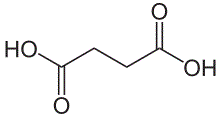
Succinic acid or butanedioic acid.

Succinic acid or butanedioic acid.

Polyester Polyol with PDMS Backbone

Title: POLYESTER POLYOL, POLYURETHANE OBTAINED USING THE SAME, PROCESS FOR PRODUCTION THEREOF, AND MOLDED POLYURETHANE

 Number/Link: US2014/0246621

Applicant/Assignee: Mitsubishi Chemical

Publication date: 4-09-2014 (priority PCT)

Gist”: A polyester polyol is prepared from a caboxylic acid-modified PDMS and a polyether diol.

Why it is interesting: A polyester polyol is prepared form a linear polydimethylsiloxane end-capped with carboxylic acid groups and having a molecular weight between about 500 and 4000 together with a polytetramethyleneether glycol with MW of 500 to 2000, such that the PDMS content is about 40% . The use of this polyol in polyurethane elastomers results in modified surface characteristics like reduced tackiness. The invention mentions fibers and films as potential applications, but this could be an interesting polyol for many other applications as well. Interesting idea but probably not new.  Only one claim appears to have survived the filing process.


Representation of the polyester polyol according to the invention

Representation of the polyester polyol according to the invention

Hydrophobic and Clear Thermoplastic Polyurethane

Title: CLEAR HYDROPHOBIC TPU

 Number/Link: WO2014/121174

Applicant/Assignee: Lubrizol

Publication date: 7-08-2014

Gist”: A hydrophobic, clear and low density TPU is prepared from 4,4’MDI, a dimer acid-based polyol and a mixture of “non-stacking” chain extenders.

Why it is interesting: Most commercial TPUs are hydrophilic to a certain extend and because of phase separation and partial crystallization are often transparent but not clear. The current invention teaches a highly hydrophobic and clear TPU made form 4,4′ MDI, a polyester polyol produced by reacting a C36 dimerized fatty acid (“dimer acid”) with 1,6-hexanediol and a chain extender mixture consisting of 1,12-dodecanediol and 2-butyl,2-ethyl propanediol or  1,4-cyclohexanedimethanol (all preferred). Hardblock content in the examples is between 25 and about 45% resulting in a shore A hardness range of about 75 to 95. No thermal data are given.
While this is no doubt an interesting material, I expect this to be a single phase glass with a relatively low Tg and therefore less useful for structural applications.

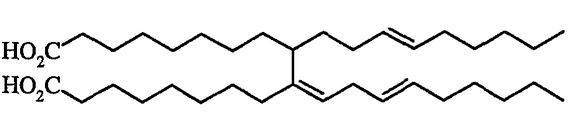
Example of a C36 dimer acid

Example of a C36 dimer acid


  • Pages

  • Categories

  • Enter your email address to follow this blog and receive notifications of new posts by email.

    Join 259 other subscribers
  • Follow Innovation in PU on Twitter