Syntactic Polyurethane Elastomers

Title: SYNTACTIC POLYURETHANE ELASTOMERS FOR USE IN SUBSEA PIPELINE INSULATION

 Number/Link: WO2015065769 WO2015065770 WO2015065771 WO2015065772

Applicant/Assignee: Dow

Publication date: 7-05-2015

Gist”: Zn/Zr catalyzed syntactic elastomers for subsea pipeline insulation

Why it is interesting: Conventional polyurethane rigid foams cannot be used for the insulation of subsea pipelines because the foams would collapse under the pressure and they are too brittle to be bent.  For these reasons syntactic elastomers can be a better choice for this application. Syntactic polyurethane elastomers consist of a solid PU matrix containing up to 50% (wt/wt) of hollow glass microspheres. The catalyst of choice to produce these materials is phenylmercury neodecanoate.  However because of regulatory pressure other catalyst systems are now being used.  The gist of these four patent applications appears to be the use of a mixture of a zinc carboxylate with a small amount of zirconium carboxylate as a replacement for the organomercury catalyst, but this is not the main claim (probably because of non-patentability). Instead the WO..69 case is about the use of polymer polyols in these systems,  the WO..70 case is about the use of low unsat polyols, WO..71 is about a special type of morphology and WO..72 about the use of prepolymers.

Phenylmercury neodecanoate
Phenylmercury neodecanoate

Hydrophobic Thermoplastic Polyurethanes

Title: POLYURETHANE

 Number/Link: US2015/0119535

Applicant/Assignee: Nippon Soda

Publication date: 30-04-2015 (priority PCT/JP)

Gist”: TPU based on a ‘hybrid’ polybutadiene-polyester polyol and an asymmetric isocyanate

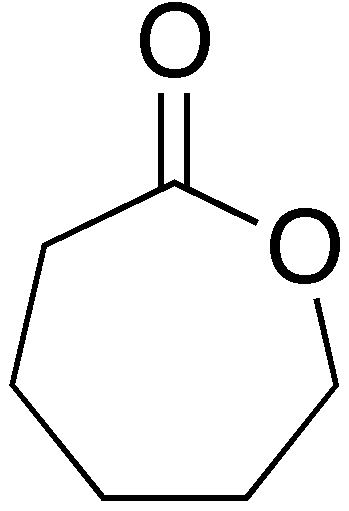
Why it is interesting: According to this invention, TPUs with excellent water-resistance can be prepared from a polyol which is made by reacting a polybutadiene diol with a mole weight of a few 1000 with a cyclic ester monomer, up to a mole weight of about 5000 to 15000 (preferred).  The resulting ‘hybdrid’  (polyester-polybutadiene-polyester) polyol is then prepolymerized with a surplus of an assymetric di-isocyanate. Finally the prepolymer is reacted with a chain extender to make the TPU. In the examples polybutadiene diols are reacted with ε-caprolactone and then with IPDI or 2,4-TDI.  The chain extender used is 1,4-butanediol. Interesting materials and (but) relatively soft as would be expected.

Caprolactone

Caprolactone

Classic PU Patent of the Month: ICI on MDI Prepolymers and “Cold Cure” Flexible Foams (1978)

Title: Liquid polyisocyanate compositions

 Number/Link:  EP10850

Applicant/Assignee: Imperial Chemical Industries

Publication date: 14-05-1980

Gist”: Liquid compositions from 2,4’/4,4′-MDI  prepolymers and polymeric MDI.

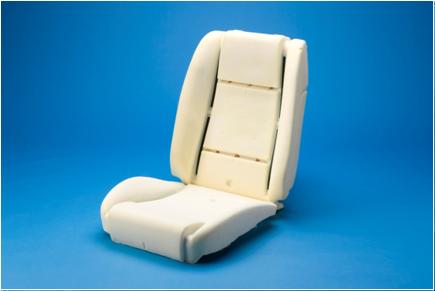
Why it is interesting: The first polyurethane flexible foams were all based on toluene diisocyanate (TDI).  Other commericially available isocyanates like “pure MDI”  (4,4’/ 2,4′- diphenylmethane diisocyanates mixtures) and “crude MDI” (mixtures of MDI and its higher homologues) were not suited for flexible foam production: the former because of it’s high crystallinity and therefore too high melting point and the latter because of its too high functionality.  This classic invention solved the problem by prepolymerizing  a 2,4’/4,4′-MDI mixture with a “flexible” polyol to an NCO content of 8 to 26% and then adding 10-50% of crude MDI to obtain a liquid composition. These liquid MDI compositions allowed the production of cold cure moulded flexible foams and the first MDI-based car seat cushions.

Cold cure moulded car seat cushions

Cold cure moulded car seat cushions

  • Pages

  • Categories

  • Enter your email address to follow this blog and receive notifications of new posts by email.

    Join 259 other subscribers
  • Follow Innovation in PU on Twitter