Cross-Linked Melt-Spun Polyurethane Fibers

Title: ISOCYANATE PREPOLYMER COMPOSITION AND CROSSLINKED POLYURETHANE PREPARED THEREFROM

 Number/Link: WO2015/007731

Applicant/Assignee: BASF

Publication date: 22-01-2015

Gist”: Melt spinning a TPU – prepolymer blend.

Why it is interesting: Crosslinked polyurethane fibers are produced by melt-spinning a thermoplastic polyurethane which is melt-blended with a specific isocyanate prepolymer composition.  The prepolymer composition is a mixture of a polymeric MDI and the reaction product of a polyester polyol and an excess of 4.4′-MDI. The polyester polyol is prepared from adipic acid together with 2-methyl-1,3-propanediol (MPdiol) and/or trimethylolpropane. The prepolymer composition is characterized by its low viscosity (probably due to the use of the branched polyester).  The crosslinked fibers show an improved tensile set and temperature resistance.
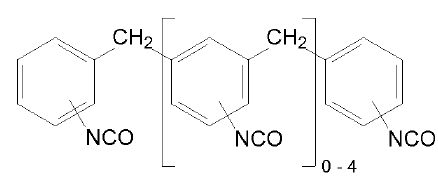
Polymeric MDI

Polymeric MDI

A New Type of Ultra-Soft Thermoplastic Polyurethanes

Title: THERMOPLASTIC POLYURETHANES WITH CRYSTALLINE CHAIN ENDS

 Number/Link: WO2014/070426

Applicant/Assignee: Lubrizol

Publication date: 8-05-2014

Gist”: Easily processable, plasticizer-free ultra-soft TPU can be produced by incorporating a crystallizing polyolefin chain stopper.

Why it is interesting: It is well known that TPU with a shore hardness below about 65A is hard to produce and process because of its stickiness and low solidification/crystallization rate. According to the invention this problem can be solved by using a crystalline chain stopper in addition to the polyol, chain extender and di-isocyanate. The chain stopper is (preferably) a c20 to c70 polyolefin mono-alcohol. Apart from improving processability at low hardness, the incoproration of the olefin chain stopper also improves compatibility of the TPU with olefin thermoplastics.  The chain stopper can also be grafted with e.g. a vinyl alkoxysilane to make a hybrid crosslinkable TPU.  An interesting idea with many potential advantages and interesting effects.

Lubrizol logo

Lubrizol logo

Water Soluble Polyurethane “Star Polymers”

Title: MULTI-ARM HYDROPHILIC URETHANE POLYMERS, METHODS OF MAKING THEM, AND COMPOSITIONS AND PROCESSES EMPLOYING THEM

 Number/Link: US2014/038874

Applicant/Assignee: Stepan

Publication date: 6-02-2014

Gist”: PU star polymers, useful as surfactants, are prepared from a polyhydroxy ‘core’ molecule, a diisocyanate and a surplus of PEG.

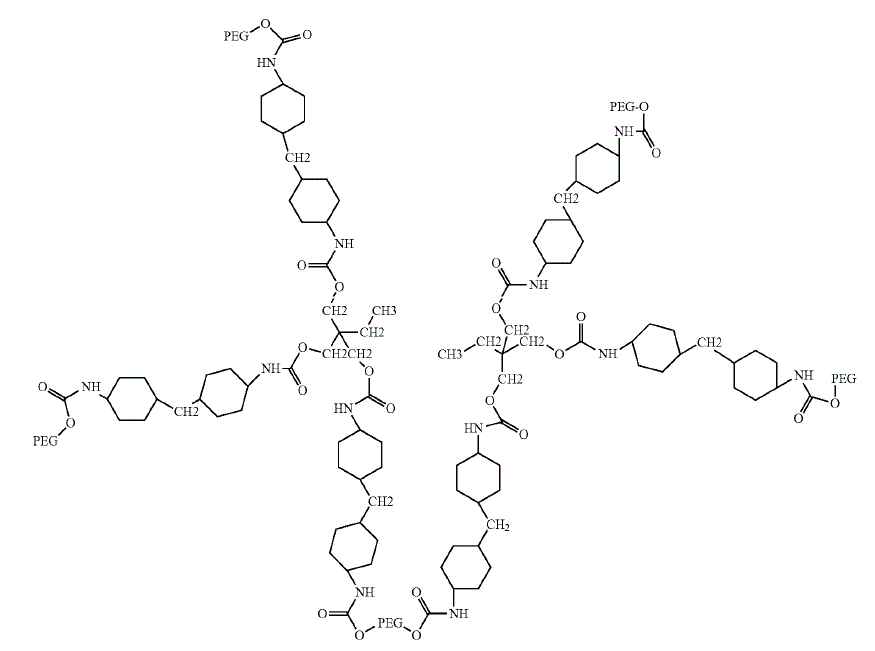
Why it is interesting: A low MW ‘core’ molecule with an OH functionality of up to 6 is reacted with a surplus of diisocyanate to form an NCO ended prepolymer. The prepolymer is then reacted with a suplus of a polyethylene glycol (PEG).  Reactants and ratios are chosen such that the average MW of the resulting product is less than about 10,000 and is water soluble or at least water dispersible. In an example trimethylolpropane is reacted with dicyclohexylmethane di-isocyanate (H12MDI) and ‘capped’ with PEG 400,  resulting in a mixture of structures, one of which is shown below.  The star polymers are supposedly useful as surfactants for use in detergents etc..
While these are interesting molecules, I doubt that these stuctures can be controlled finely enough to compete with established surfactants. I might be more interesting to use methoxy PEGs (i.e. monols) instead of PEGs.

Example of a PU star polymer.

Example of a PU star polymer.

  • Pages

  • Categories

  • Enter your email address to follow this blog and receive notifications of new posts by email.

    Join 259 other subscribers
  • Follow Innovation in PU on Twitter