PPE-Filled Rigid Foams

Title: RIGID FOAM AND ASSOCIATED ARTICLE AND METHOD

 Number/Link: WO2015/012989

Applicant/Assignee: SABIC

Publication date: 29-01-2015

Gist”: Rigid polyurethane foams containing polyphenylene ether particles

Why it is interesting: This invention is about rigid PU or PIR (polyisocyanurate) foams containing up to 25% w/w on the total composition of poly(2,6-dimethyl-1,4-phenylenether) particles.  The particles have a mean particle size of about 6 µm and are prepared by jet milling a commercial grade of PPE powder. The resulting foams are said to have reduced flammability and water absorption.  This is the second patent application that SABIC files on PPE-PU hybrids or combinations.  An interesting development but it is hard to believe that these ideas are practical and economical.

poly(2,6-dimethyl-1,4-phenyleneether)

poly(2,6-dimethyl-1,4-phenylene ether)

Polyester Polyol with PDMS Backbone

Title: POLYESTER POLYOL, POLYURETHANE OBTAINED USING THE SAME, PROCESS FOR PRODUCTION THEREOF, AND MOLDED POLYURETHANE

 Number/Link: US2014/0246621

Applicant/Assignee: Mitsubishi Chemical

Publication date: 4-09-2014 (priority PCT)

Gist”: A polyester polyol is prepared from a caboxylic acid-modified PDMS and a polyether diol.

Why it is interesting: A polyester polyol is prepared form a linear polydimethylsiloxane end-capped with carboxylic acid groups and having a molecular weight between about 500 and 4000 together with a polytetramethyleneether glycol with MW of 500 to 2000, such that the PDMS content is about 40% . The use of this polyol in polyurethane elastomers results in modified surface characteristics like reduced tackiness. The invention mentions fibers and films as potential applications, but this could be an interesting polyol for many other applications as well. Interesting idea but probably not new.  Only one claim appears to have survived the filing process.


Representation of the polyester polyol according to the invention

Representation of the polyester polyol according to the invention

Reactive Cellopener for Polyurethane Rigid Foams

Title: REACTIVE CELL OPENER COMPOSITION, POLYOL COMPOSITION, AND OPEN-CELLED POLYURETHANE FOAM

 Number/Link: US2014/0231708

Applicant/Assignee: LG Electronics

Publication date: 21-08-2014

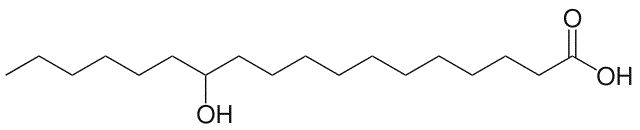
Gist”:  A silicon oil together with the lithium-salt of 12-hydroxystearic acid is used as cellopener for rigid VIP foams.

Why it is interesting: While coventional rigid insulation foams are closed-celled, rigid foams for use in vacuum insulation panels (VIPs) need to have a very high open cell content together with a cell size which is as small as possible. The current invention relates to reactive cellopeners comprising a silicone ‘base’ oil and the metal salt of a fatty acid having a (isocyanate-reactive) hydroxy group.  In an example the Li-salt of of 12-hydroxystearic acid is produced from LiOH and the fatty acid using a silicone oil as reaction medium. The composition, having a 30% solids content, is then used as a cellopener in a rigid foam formulation resulting in a cell size of about 90μm and 98% open cell content at a density of about 50 kg/m³. A perfluoroalkane nucleating agent was used as well.

12-hydroxystearic acid

12-hydroxystearic acid


  • Pages

  • Categories

  • Enter your email address to follow this blog and receive notifications of new posts by email.

    Join 259 other subscribers
  • Follow Innovation in PU on Twitter