Hydrophobic Thermoplastic Polyurethanes

Title: POLYURETHANE

 Number/Link: US2015/0119535

Applicant/Assignee: Nippon Soda

Publication date: 30-04-2015 (priority PCT/JP)

Gist”: TPU based on a ‘hybrid’ polybutadiene-polyester polyol and an asymmetric isocyanate

Why it is interesting: According to this invention, TPUs with excellent water-resistance can be prepared from a polyol which is made by reacting a polybutadiene diol with a mole weight of a few 1000 with a cyclic ester monomer, up to a mole weight of about 5000 to 15000 (preferred).  The resulting ‘hybdrid’  (polyester-polybutadiene-polyester) polyol is then prepolymerized with a surplus of an assymetric di-isocyanate. Finally the prepolymer is reacted with a chain extender to make the TPU. In the examples polybutadiene diols are reacted with ε-caprolactone and then with IPDI or 2,4-TDI.  The chain extender used is 1,4-butanediol. Interesting materials and (but) relatively soft as would be expected.
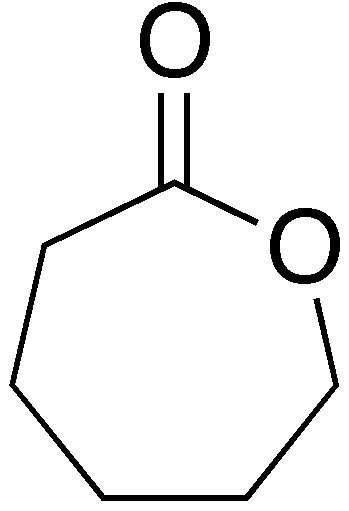
Caprolactone

Caprolactone

Polyurethane Rigid Foam Containing Lignin

Title: COMPOSITIONS OF PHENOLIC BIOPOLYMERS

 Number/Link:WO2015/055662

Applicant/Assignee: Solvay

Publication date: 23-04-2015

Gist”: Lignin is emulsified in a halogenated polyol and then used to prepare rigid foams.

Why it is interesting: This case is about yet another attempt to incorporate lignin into polyurethane materials. In this invention lignin is dispersed in a halogenated polyol using a suitable milling process. The polyol is preferably a brominated ‘rigid’ polyether.  The dispersed lignin (pref.) has a (d90) mean particle size of less than 100μm and is used in an amount of up to about 50% on the brominated polyether.  The lignin dispersion can then be used together with other polyols in rigid foam formulations.  The resulting foams should have improved flammability properties and the lignin is said to have no negative effect on thermal insulation properties.

Part of a typical lignin structure

Part of a typical lignin structure


Superhydrophobic Polyurethane Coatings

Title: POLYMERS FOR MAKING SUPERHYDROPHOBIC SURFACES

 Number/Link: WO2015/047196

Applicant/Assignee: AGENCY FOR SCIENCE, TECHNOLOGY AND RESEARCH

Publication date: 2-04-2015

Gist”: A comb polymer with hydrophobic side chains and an isocyanate-reactive backbone is reacted with an NCO-ended prepolymer.

Why it is interesting: Superhydrophobic surfaces show a contact angle (vs water) of 150° or more. Water therefore forms almost perfectly spherical droplets on such a surface which easily roll off: the so-called “lotus-effect”. Superhydrophobic surfaces can find important applications in e.g. automotive and aviation industries. The current invention relates to a superhydrophobic coating composition comprising a hydrophobic comb-polymer having an NCO-reactive backbone together with a polyurethane prepolymer.  The comb polymer is prepared by alkylating an unsaturated epoxy monomer with a nucleophile comprising a C8 to C20 alkyl group, followed by polymerization. The resulting comb polymer can then be combined with an NCO-ended polyurethane prepolymer to make a superhydrophobic coating composition. In an example hexadecylamine is reacted with glycidylmethacrylate resulting in 3-(hexadecylamino)-2-hydroxypropylmethacrylate which is then polymerized into a comb-like polymer. After separation and drying the comb polymer is combined with a commercial (solvent-based) polyurethane prepolymer to make the coating composition.

Glycidylmethacrylate

Glycidylmethacrylate


  • Pages

  • Categories

  • Enter your email address to follow this blog and receive notifications of new posts by email.

    Join 259 other subscribers
  • Follow Innovation in PU on Twitter