Water Soluble Polyurethane “Star Polymers”

Title: MULTI-ARM HYDROPHILIC URETHANE POLYMERS, METHODS OF MAKING THEM, AND COMPOSITIONS AND PROCESSES EMPLOYING THEM

 Number/Link: US2014/038874

Applicant/Assignee: Stepan

Publication date: 6-02-2014

Gist”: PU star polymers, useful as surfactants, are prepared from a polyhydroxy ‘core’ molecule, a diisocyanate and a surplus of PEG.

Why it is interesting: A low MW ‘core’ molecule with an OH functionality of up to 6 is reacted with a surplus of diisocyanate to form an NCO ended prepolymer. The prepolymer is then reacted with a suplus of a polyethylene glycol (PEG).  Reactants and ratios are chosen such that the average MW of the resulting product is less than about 10,000 and is water soluble or at least water dispersible. In an example trimethylolpropane is reacted with dicyclohexylmethane di-isocyanate (H12MDI) and ‘capped’ with PEG 400,  resulting in a mixture of structures, one of which is shown below.  The star polymers are supposedly useful as surfactants for use in detergents etc..
While these are interesting molecules, I doubt that these stuctures can be controlled finely enough to compete with established surfactants. I might be more interesting to use methoxy PEGs (i.e. monols) instead of PEGs.
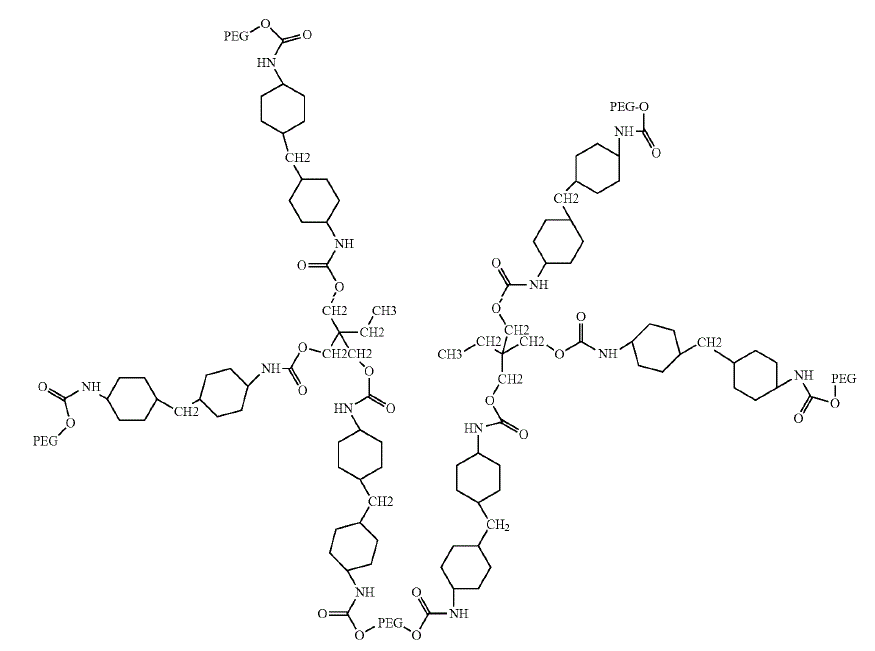
Example of a PU star polymer.
Example of a PU star polymer.

Nanocomposites from PIB-Based Polyurethane and Clay

Title: POLYISOBUTYLENE-BASED POLYURETHANES CONTAINING ORGANICALLY MODIFIED MONTMORILLONITE

 Number/Link: WO/2014/018509

Applicant/Assignee: UNIVERSITY OF AKRON

Publication date: 30-01-2014

Gist”: A small amount of montmorillonite, modified with a quaternary ammonium compound containing an amine group, is incorporated in a polyisobutylene-based TPU.

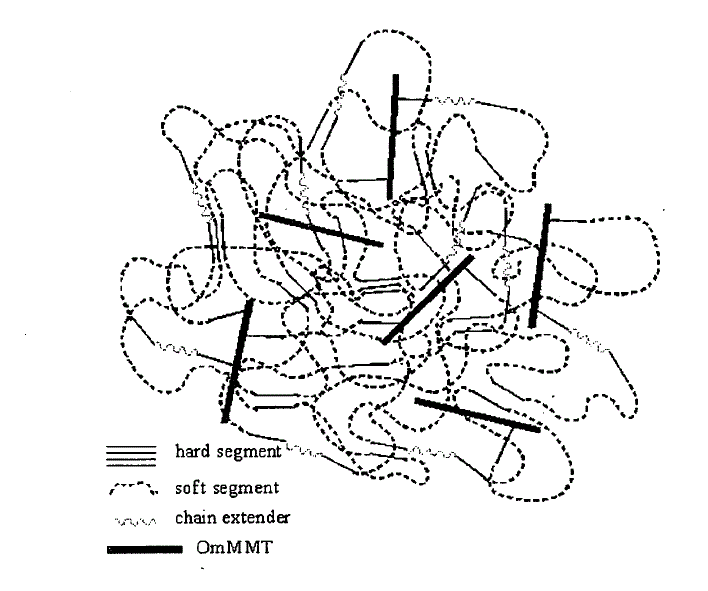
Why it is interesting: Montmorillonite-type clay is “exfoliated” using a quat. ammonium compound which has an alkyl subsituent containing a primary amine group. The salt group will electrostatically interact with the clay while the amine group will react with isocyanate when used in a polyurethane formulation, thus incorporating the clay into the polymer structure. In an example a (T)PU is made from HMDI, 1,6-hexanediol and a mixture of a 4000MW polyisobutylene diol and a 1000MW PTMO diol. A montmorillonite was exfoliated using trimethyl-1-propylamine ammonium iodide (I¯N+(CH3)3CH2CH2CH2-NH2)  and incorporated in the PU to make the nanocomposite. In an amount of 0.5% (w/w) the clay increases stiffness, mechanical- and creep properties of the PU.  However at higher amounts (2%,5%..) these properties actually deteriorate.

Polymer morphology model according to the invention.  (omMMT = organically modified montmorrilonite)

Polymer morphology model according to the invention. (omMMT = organically modified montmorillonite)

Polyurethane Foam Containing Iron Particles for Improved Oil Absorption

Title: ABSORBENT MATERIAL

 Number/Link: WO2014/008554

Applicant/Assignee: Advanced Simplicity Technologies

Publication date: 16-01-2014

Gist”: Incorporation of iron particles improves the oil-absorbing capacity of PU foams.

Why it is interesting: The mineral-oil absorbing capacity of PU foam is well known and documented (see e.g. WO/1995/031402  and WO/1999/005066 ).  Current invention claims that the oil absorbing capacity of the foam can be greatly improved by incorporating inorganic particles, esp. metallic iron or silica. The particle size of the particles is chosen such as to protrude the foam cell walls so that they are exposed inside the foam pores (pref. 50 to 200μm). In an example an MDI-based  foam containing 70% (w/w) of iron powder was shown to absorb about 10g of oil per gram of foam.

Oils Spill at Sea

Oils Spill at Sea

  • Pages

  • Categories

  • Enter your email address to follow this blog and receive notifications of new posts by email.

    Join 259 other subscribers
  • Follow Innovation in PU on Twitter