PU-FPOSS Coating Compositions

Title: ICE ADHESION REDUCING PREPOLYMERS AND POLYMERS

Number/Link: US20170204291

Applicant/Assignee: Boeing

Publication Date: 20 July 2017  (published as PCT)

“Gist”: Ice repellent polyurethane coatings are prepared by incorporating F-POSS prepolymers

Why it is interesting: The invention is about coated surfaces that show reduced ice formation and/or adhesion. This is accomplished by incorporating fluorinated polyhedral oligomeric silsesquioxanes (F-POSS) into the composition. OH-functional F-POSS is prepared as per the scheme below, which is then reacted with polyisocyanates to prepare an NCO-functional F-POSS prepolymer.  The prepolymer can then be used in PU coating compositions, or reacted with amino-functional PDMS compounds and used as an additive in coating compositions.
It is believed that the F-POSS particles interfere with H-bond formation of ice to the coated surface.  Ice repellent surfaces are particularly useful for aircraft, wind turbines, cooling equipment and the like.
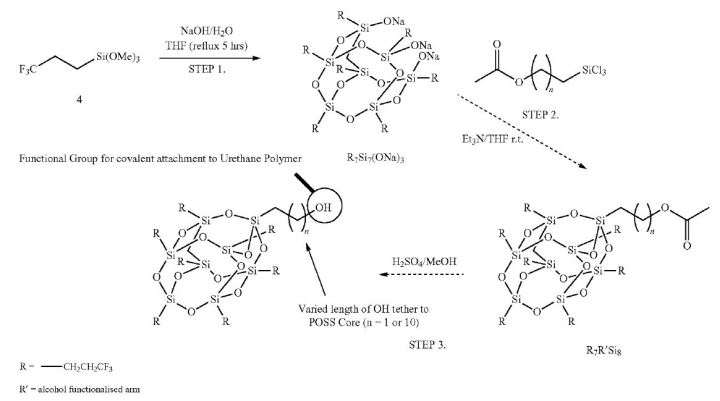
Synthesis of OH-functional trifluoropropyl POSS

Matte, Self-Healing Polyurethane Powder Coatings

Title: POLYURETHANE COATING COMPOSITION

Number/Link: WO2017/074835

Applicant/Assignee: Valspar

Publication Date: 4 May 2017

“Gist”: Coating composition comprising isocyanate and two polyester polyols having a similar Tg but a widely different equivalent weight.

Why it is interesting: Conventionally low gloss or “matte” coatings are the result of a microtextured surface achieved by certain fillers or by incompatible polymers and the like. According to this invention “ultra matte” finishes can also -surprisingly- be achieved from a (powder) coating composition comprising a (blocked) isocyanate and a mixture of two polyester polyols. Both polyols have a Tg between 40 and 60ºC prefereably differing not more than 5 to 8ºC, while the OHv of the first polyol is between 150 and 325 and that of the second between 15 and 35.  The ratio between first and second polyol is from about 1:1 to 1:3 w/w. Also surprisingly, the resulting coatings are said to show self-healing properties. An interesting composition but no examples of the polyesters or isocyanates used are given.

Car with matte finish

Moisture Scavenger for Polyurethane Coatings

Title: PROCESSES FOR MOISTURE SCAVENGING IN PREPARING POLYURETHANE COATINGS AND COMPOSITIONS THEREFOR

Number/Link: US2017/0114247

Applicant/Assignee: Achiewell

Publication Date: 27-april-2017

“Gist”: Methoxysilicon compound with e-withdrawing group together with hydrophobic t-amine catalyst acts as moisture scavenger

Why it is interesting:  Moisture in PU coating compositions can be a problem because it negatively affects both the properties of the composition (pot life and viscosity..) and of the final coating. Moisture scavengers like molecular sieves are well known but often have a negative impact as well. According to this invention, methoxyorganosilicon compounds with at least one electron withdrawing group attached to the silicon atom act as efficient moisture scavengers when used in combination with a hydrophobic tert-methylamine catalyst. Preferred organosilicon compounds have 3 methoxy substituents and one hydrocarbon-based e-withdrawing group, like e.g. fluoroethyltrimethoxysilane. A preferred catalyst is 1,3-bis[3-dimethylaminopropyl]urea (claimed).  No examples are given.

1,3-bis[3-dimethylaminopropyl]urea

  • Pages

  • Categories

  • Enter your email address to follow this blog and receive notifications of new posts by email.

    Join 259 other subscribers
  • Follow Innovation in PU on Twitter