A Simple Way to Make Nonflammable Flexible Foams

Title: METHOD FOR PRODUCING FLAME-PROTECTED POLYURETHANE FOAMS HAVING LOW BULK DENSITIES

 Number/Link: WO2013174745  (German)

Applicant/Assignee: Bayer

Publication date: 28-11-2013

Gist”: Low density flex foam is impregnated with water glass

Why it is interesting: A flexible slabstock foam with a density of about 15 kg/m³ or less is submerged in a solution of amorphous water-slouble silicate, preferably a  Na-silicate, then compressed in a roller mill and dried.  The resulting foam has a (much) higher density but also a much improved flame resistance.  In an example an 11.6 kg/m³ TDI slab foam resulted in a 27.3 kg/m³ density foam after impregnation and drying.  A simple and workable idea but I doubt if it is patentable.
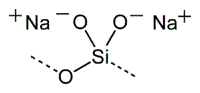
Sodium silicate

Sodium silicate

Very Tough Polyurethane Elastomers Based on a Novel Type of Polyester Polyol

Title: POLYESTER POLYOL FOR USE IN POLYURETHANE

 Number/Link: WO2013/156450

Applicant/Assignee: Purac Biochem

Publication date: 24-10-2013

Gist”: Tough polyurethane elastomers can be prepared from polyester polyols based on dimer acid and lactide oligomers.

Why it is interesting: The invention claims a new type of ABA polyester polyol where A is a hydrophilic lactide oligomer and B is a hydrophobic dimer diacid initiator. The lactide ologimers can be produced by ring-opening polymerization of cyclic lactide and preferably contain between 4 and 16 lactoyl units.  The dimer diacid is prepared by dimerizing unsaturated C12 to C22 fatty acids, preferably linoleic or linolenic acid. The molecular weight of the polyester polyol is preferably between 1000 and 3500 dalton. Solid polyurethane elastomers prepared from this type of polyols reportedly have much improved toughness and other mechanical properties.

Example of a Dimer Acid

Example of a Dimer Acid

Polyurethane Particles for Oil Absorption

Title: METHOD FOR PRODUCING POLYURETHANE PARTICLES

 Number/Link: US2013/0224376

Applicant/Assignee: Konishi Co.

Publication date: 29-08-2013

Gist”: A PU latex is prepared from an emulsion of an NCO-prepolymer in water which is crosslinked with a  triamine in the presence of hydrophilic silica particles. The latex is then spray dried to form oil absorbing particles.

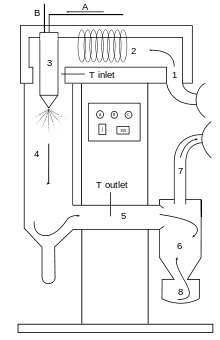
Why it is interesting: An NCO-ended IPDI-PTMEG prepolymer is dispersed in water an then crosslinked with a triamine.  To the resulting latex, hydrophilic silica particles are added and the composition is then sprayed into a high temperature atmosphere to evaporate the water and form the particles. The size of the silica particles is about 20 nm and a factor 30 smaller then the PU particles. The silica supposedly covers the PU particles so that they do not cohere and show good flow properties. The particles can be used to absorb natural  fats and oils (triglycerids)   Useful (I assume) in the pharmaceutical, cosmetic and agricultural industries (controlled release, perfumes, repellents..)

lab spraydryer schematic (Wikipedia)

lab spraydryer schematic (Wikipedia)

  • Pages

  • Categories

  • Enter your email address to follow this blog and receive notifications of new posts by email.

    Join 259 other subscribers
  • Follow Innovation in PU on Twitter