Classic PU Patent of the Month: The First Polyether Foams (1951)

Title: Verfahren zur Herstellung von Kunststoffen

 Number/Link: DE974371 (German)

Applicant/Assignee: Bayer AG

Publication date: 12-08-1960

Gist”: A prepolymer from a polyether polyol and an excess of isocyanate is reacted with water to produce an elastomeric  foam.

Why it is interesting: This patent specifies the first polyether prepolymers and polyether  foams as invented by Otto Bayer and co-workers.  In the examples an all-EO, 4000 MW triol, prepared from trimethylolpropane and  ethylene oxide is reacted with a surplus of TDI resulting in a 3.2% NCO prepolymer.  This prepolymer is reacted with water to form either elastomeric films or elastomeric (flexible) foams. There are only two claims, the first covering  polyether prepolymers, the second covering both “one-shot” and “full prepolymer” water-blown polyether foams:

PATENTANSPRÜCHE:

1. Verfahren zur Herstellung von Kunststoffen,
dadurch gekennzeichnet, daβ Polyglykolather mit
einem Molekulargewicht von mindestens 500 und
mindestens zwei endstandigen Hydroxylgruppen
mit einem Übersehuβ über die berechnete Menge
an polyfunktionellen aliphatischen oder aromatischen
Isocyanaten und die erhaltenen Polyglykolätherisocyanate
mit Verbindungen mit reaktionsfahigem Wasserstoff
umgesetzt werden.

2. Ausführungsform des Verfahrens nach Anspruch
1, insbesondere zur Herstellung von Schaumstoffen,
dadurch gekennzeichnet, daβ als Verbindung
mit reaktionsfahigem Wasserstoff Wasser verwendet
wird und die Umsetzung mit Wasser gleichzeitig
mit der oder anschlieβend an die Umsetzung
der Polyglykolather und polyfunktionellen
Isocyanate erfolgt.

Dr. Otto Bayer
Dr. Otto Bayer

Water Soluble Polyurethane “Star Polymers”

Title: MULTI-ARM HYDROPHILIC URETHANE POLYMERS, METHODS OF MAKING THEM, AND COMPOSITIONS AND PROCESSES EMPLOYING THEM

 Number/Link: US2014/038874

Applicant/Assignee: Stepan

Publication date: 6-02-2014

Gist”: PU star polymers, useful as surfactants, are prepared from a polyhydroxy ‘core’ molecule, a diisocyanate and a surplus of PEG.

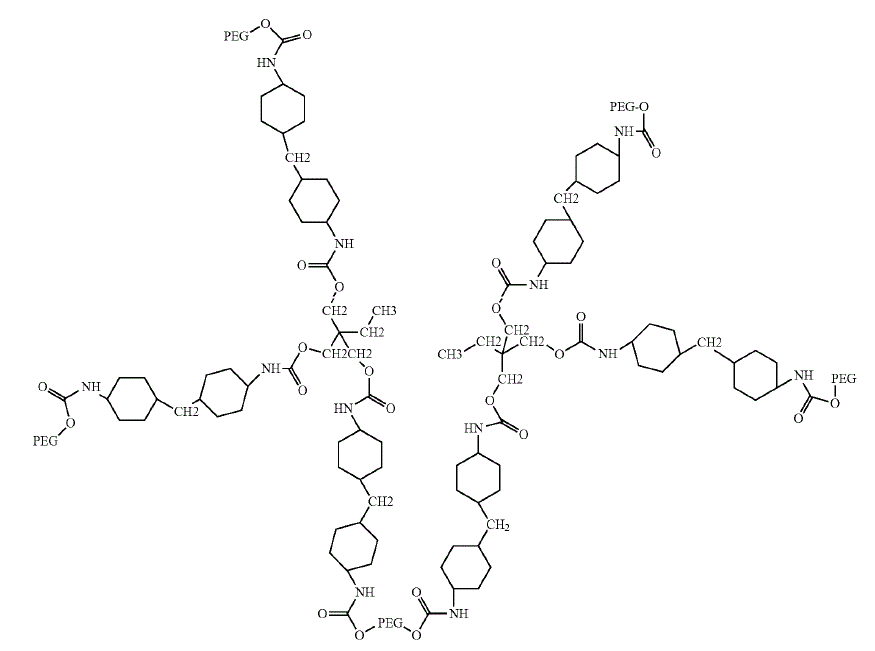
Why it is interesting: A low MW ‘core’ molecule with an OH functionality of up to 6 is reacted with a surplus of diisocyanate to form an NCO ended prepolymer. The prepolymer is then reacted with a suplus of a polyethylene glycol (PEG).  Reactants and ratios are chosen such that the average MW of the resulting product is less than about 10,000 and is water soluble or at least water dispersible. In an example trimethylolpropane is reacted with dicyclohexylmethane di-isocyanate (H12MDI) and ‘capped’ with PEG 400,  resulting in a mixture of structures, one of which is shown below.  The star polymers are supposedly useful as surfactants for use in detergents etc..
While these are interesting molecules, I doubt that these stuctures can be controlled finely enough to compete with established surfactants. I might be more interesting to use methoxy PEGs (i.e. monols) instead of PEGs.

Example of a PU star polymer.

Example of a PU star polymer.

Polyurethane Foam Containing Iron Particles for Improved Oil Absorption

Title: ABSORBENT MATERIAL

 Number/Link: WO2014/008554

Applicant/Assignee: Advanced Simplicity Technologies

Publication date: 16-01-2014

Gist”: Incorporation of iron particles improves the oil-absorbing capacity of PU foams.

Why it is interesting: The mineral-oil absorbing capacity of PU foam is well known and documented (see e.g. WO/1995/031402  and WO/1999/005066 ).  Current invention claims that the oil absorbing capacity of the foam can be greatly improved by incorporating inorganic particles, esp. metallic iron or silica. The particle size of the particles is chosen such as to protrude the foam cell walls so that they are exposed inside the foam pores (pref. 50 to 200μm). In an example an MDI-based  foam containing 70% (w/w) of iron powder was shown to absorb about 10g of oil per gram of foam.

Oils Spill at Sea

Oils Spill at Sea

  • Pages

  • Categories

  • Enter your email address to follow this blog and receive notifications of new posts by email.

    Join 259 other subscribers
  • Follow Innovation in PU on Twitter