Urethane-Acrylate Latex

Patent Title: HIGH SOLIDS, LOW VISCOSITY URETHANE-LINKAGE CONTAINING LATEX AND METHOD OF PRODUCTION THEREOF

 Number/Link: WO2015/195466

Applicant/Assignee: Arkema

Publication date: 23-12-2015

Gist”: Simultaneous emulsion polymerization of acrylate, hydroxyacrylate and diisocyanate

Why it is interesting: According to this invention a low viscosity and high solid-content latex, containing urethane bonds, can be produced by emulsion polymerization of a diisocyanate  and a mixture of ethylenically unsaturated monomers some of which are isocyanate-reactive. In an example H12MDI is emulsified in water together with hydroxyethyl acrylate, a mixture of other acrylate monomers and an appropriate surfactant.  The emulsion is then polymerized using a peroxide. The resulting latex had a solid content of 52% at a visosity of 480 cP.  The latex is said to be especially useful for coatings with improved chemical resistance and toughness.

Hydroxyethyl acrylate

Hydroxyethyl acrylate

UV Crosslinkable TPU

Title: BREATHABLE AND CROSSLINKABLE THERMOPLASTIC POLYURETHANE

 Number/Link:  WO2015/164695

Applicant/Assignee: Lubrizol

Publication date: 29-10-2015

Gist”: TPU composition containing unsaturated polyester diol and long chain monol

Why it is interesting: A soft, plasticizer-free, TPU with low processing temperature and curable by UV light can be produced by incorporating an unsaturated polyester diol and a linear C20-C65 monol. The unsaturated polyester can e.g. be prepared from butanediol, adipic acid and some trimethylolpropane monallylether.  The TPU is said to be especially useful as UV curable adhesive for fabrics.

Trimethylolpropane monoallyl ether

Trimethylolpropane monoallyl ether


TPU from POM-Polyether Polyols

Title: THERMOPLASTIC POLYURETHANES, PRODUCTION AND USE THEREOF

 Number/Link: WO2015/155084  (German)

Applicant/Assignee: Bayer

Publication date: 15-10-2015

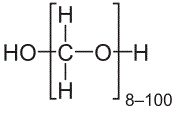
Gist”: Paraformaldehyde-PO polyols are used to make TPU

Why it is interesting: Polyoxymethylene (POM) is a highly crystalline ‘engineering thermoplastic’ often used in blends together with TPU. In this invention POM is not blended but used to make a POM-polyether ‘block’ diol which is then used to make TPU. The diol is prepared by using paraformaldehyde as a starter which is reacted with PO (and optionally CO2) using DMC catalysis. The POM-block acts as a ‘hard block’ and use of the diol allows for an improved control of Tg, melt viscosity, hardness, chemical resistance etc. of the TPU.  In the examples TPU is made from a 2000 MW parafomaldehyde/PO-CO2 block copolymer  together with 4,4’MDI and BDO.

Paraformaldehyde

Paraformaldehyde

  • Pages

  • Categories

  • Enter your email address to follow this blog and receive notifications of new posts by email.

    Join 259 other subscribers
  • Follow Innovation in PU on Twitter