Hydrophobic Thermoplastic Polyurethanes

Title: POLYURETHANE

 Number/Link: US2015/0119535

Applicant/Assignee: Nippon Soda

Publication date: 30-04-2015 (priority PCT/JP)

Gist”: TPU based on a ‘hybrid’ polybutadiene-polyester polyol and an asymmetric isocyanate

Why it is interesting: According to this invention, TPUs with excellent water-resistance can be prepared from a polyol which is made by reacting a polybutadiene diol with a mole weight of a few 1000 with a cyclic ester monomer, up to a mole weight of about 5000 to 15000 (preferred).  The resulting ‘hybdrid’  (polyester-polybutadiene-polyester) polyol is then prepolymerized with a surplus of an assymetric di-isocyanate. Finally the prepolymer is reacted with a chain extender to make the TPU. In the examples polybutadiene diols are reacted with ε-caprolactone and then with IPDI or 2,4-TDI.  The chain extender used is 1,4-butanediol. Interesting materials and (but) relatively soft as would be expected.
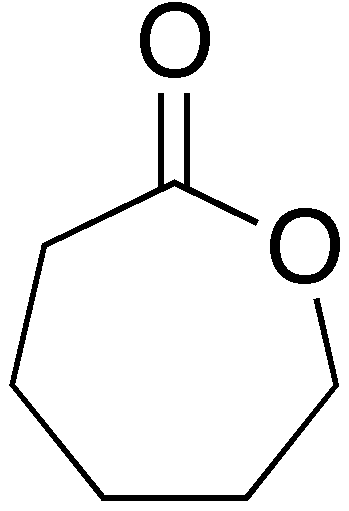
Caprolactone

Caprolactone

Superhydrophobic Polyurethane Coatings

Title: POLYMERS FOR MAKING SUPERHYDROPHOBIC SURFACES

 Number/Link: WO2015/047196

Applicant/Assignee: AGENCY FOR SCIENCE, TECHNOLOGY AND RESEARCH

Publication date: 2-04-2015

Gist”: A comb polymer with hydrophobic side chains and an isocyanate-reactive backbone is reacted with an NCO-ended prepolymer.

Why it is interesting: Superhydrophobic surfaces show a contact angle (vs water) of 150° or more. Water therefore forms almost perfectly spherical droplets on such a surface which easily roll off: the so-called “lotus-effect”. Superhydrophobic surfaces can find important applications in e.g. automotive and aviation industries. The current invention relates to a superhydrophobic coating composition comprising a hydrophobic comb-polymer having an NCO-reactive backbone together with a polyurethane prepolymer.  The comb polymer is prepared by alkylating an unsaturated epoxy monomer with a nucleophile comprising a C8 to C20 alkyl group, followed by polymerization. The resulting comb polymer can then be combined with an NCO-ended polyurethane prepolymer to make a superhydrophobic coating composition. In an example hexadecylamine is reacted with glycidylmethacrylate resulting in 3-(hexadecylamino)-2-hydroxypropylmethacrylate which is then polymerized into a comb-like polymer. After separation and drying the comb polymer is combined with a commercial (solvent-based) polyurethane prepolymer to make the coating composition.

Glycidylmethacrylate

Glycidylmethacrylate


PPE-Filled Rigid Foams

Title: RIGID FOAM AND ASSOCIATED ARTICLE AND METHOD

 Number/Link: WO2015/012989

Applicant/Assignee: SABIC

Publication date: 29-01-2015

Gist”: Rigid polyurethane foams containing polyphenylene ether particles

Why it is interesting: This invention is about rigid PU or PIR (polyisocyanurate) foams containing up to 25% w/w on the total composition of poly(2,6-dimethyl-1,4-phenylenether) particles.  The particles have a mean particle size of about 6 µm and are prepared by jet milling a commercial grade of PPE powder. The resulting foams are said to have reduced flammability and water absorption.  This is the second patent application that SABIC files on PPE-PU hybrids or combinations.  An interesting development but it is hard to believe that these ideas are practical and economical.

poly(2,6-dimethyl-1,4-phenyleneether)

poly(2,6-dimethyl-1,4-phenylene ether)

  • Pages

  • Categories

  • Enter your email address to follow this blog and receive notifications of new posts by email.

    Join 259 other subscribers
  • Follow Innovation in PU on Twitter