Modified Polyisocyanurates

Patent Title: MODIFIED POLYISOCYANURA TE PLASTIC AND METHOD FOR PRODUCTION THEREOF

 Number/Link: WO2017/182108 WO2017/182109  WO2017/182110  (German)  

Applicant/Assignee:  Covestro

Publication date: 26-october-2017

Gist”: Partially trimerized diisocyanates are modified with monofunctional isocyanate-reactive compounds before complete trimerization

Why it is interesting: This series of applications relates to transparent polyisocyanurate coatings with controlled hydrophilicty, hydrophobicity, high scratch resitance etc. According to the invention trimers of diisocanates are reacted with a sub-stoichiometric amount of monofunctional hydrophobic, hydrophilic or siloxane-containing compounds, and then completely trimerized. In the examples HDI-trimer (prepared by partially trimerzing HDI and removing the rest of the monomer by thin film distillation) is reacted with e.g. methoxyPEG 500, dodecanol, perfluoroheptanol and N-(3-trimethoxyxilylpropyl)foramide and then trimerized using potassium acetate as catalyst.  The materials can e.g. be used as anti-fog coatings on optical lenses or anti-fingerprint coatings on cell phones.
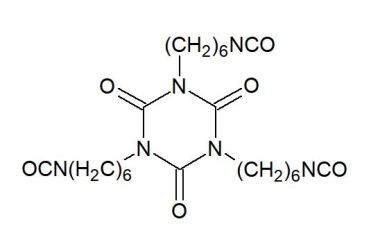
HDI-isocyanurate

Polythiourethanes for 3D Printing

Patent Title:  THIOURETHANE POLYMERS, METHOD OF SYNTHESIS THEREOF AND USE IN ADDITIVE MANUFACTURING TECHNOLOGIES

 Number/Link: WO2017/160810

Applicant/Assignee:  Univ. Texas

Publication date: 21-September-2017

Gist”: Photolatent bases are used to catalyse the polythiol-polyisocyanate reaction

Why it is interesting: According to this invention reactive systems useful for additive manufacturing processes can be prepared from polythiols, diisocyanates and a photolatent base.  When irradiated the photolatent base will split off a non-nucleophilic base which will catalyse the thiol-isocyanate reaction. The systems can be prepared such that the resulting materials show improved mechanical properties over current 3D printed materials.  In an example 2,2′-(ethylenedioxy)diethanethiol and pentaerithritol tetrakis(3-mercaptopropionate) are reacted with HDI using 1,1-dimethyl-1-(2-hydroxypropyl)amine-p-nitrobenzimide (DANBA) as a photolatent base.

Example of pholatent base (DANBA)

Rigid Thermoplastic Polyurethanes

Patent Title: ISOCYANATE-MODIFIED RIGID THERMOPLASTIC POLYMER COMPOSITIONS

 Number/Link: WO2017/146948  WO2017/146949

Applicant/Assignee: Eastman Chemical

Publication date: 31 august 2017

Gist”: A “rigid”, high Tg polyester diol is extended with 4,4′ MDI

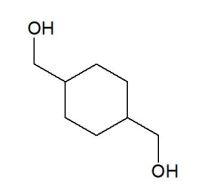
Why it is interesting: Rigid, high modulus TPUs have been known for a long time – see e.g. Upjohn’s classic patent on ‘Isoplast’ from 1981. These materials are high hardblock TPUs made from diisocyanates, chain extenders with only a small amount of high molecular weight diol as an impact modifier. According to the current invention however, rigid TPUs can be made using less than 40% (w/w) of diisocyanate, a high Tg polyester diol and optionally some chain extender.  The polyester is prepared from ‘rigid’ diols like isosorbide or 1,4-cyclohexanedimethanol together with a ‘rigid’ diacid like terephthalic acid, such that the diol has a MW of more than 400 Dalton and a Tg of more than 40°C. The diisocyanate is pref. 4,4-MDI. The rigid TPUs have a Tg of more than 145°C and a tensile modulus of 1 GPa or higher. They are said to be less moisture sensitive than conventional rigid TPUs.

1,4-cyclohexanedimethanol

  • Pages

  • Categories

  • Enter your email address to follow this blog and receive notifications of new posts by email.

    Join 259 other subscribers
  • Follow Innovation in PU on Twitter