Hydrolysis Resistant Polyester Urethane

Patent Title: HIGHLY DURABLE POLYESTER POLYOL

 Number/Link: US2017/0022143

Applicant/Assignee: Kuraray

Publication date: 26-jan-2017

Gist”: PU from polyester polyol with bulky side groups

Why it is interesting: The invention is about polyester polyols prepared from a dibasic acid (e.g adipic acid) and a mixture of two diols: 3-methyl-1,5-pentanediol and cyclohexane-1,1-dimethanol. The diols are used in a molar ratio of about 1:1 (25-75 to 75-25 pref.). Polyurethanes prepared with these polyesters are said to be highly hydrolysis resistant in both acidic and basic environments.

Cyclohexane-1,1-dimethanol

Cyclohexane-1,1-dimethanol

TPU-Silicone TPVs

Patent Title: THERMOPLASTIC POLYURETHANE COMPOSITE MATERIAL COMPOSITION, THERMOPLASTIC POLYURETHANE COMPOSITE MATERIAL AND MANUFACTURING METHOD THEREOF, SHOE MATERIAL AND WEARABLE APPARATUS

 Number/Link: US2017 /0015825

Applicant/Assignee: Evermore Chem. Ind.

Publication date: 19-jan-2017

Gist”: A blend of TPU and unsaturated silicone gum is dynamically vulcanized

Why it is interesting: A thermoplastic polyurethane is blended (in a kneader) with 1 to 5% w/w of double-unsaturated silicone rubber gum. The blend is then dynamically vulcanized by extruding (and pelletizing) it together with a peroxide curing agent like e.g. 1,3-bis-(t-butylperoxyisopropyl)benzene. The resulting thermoplastic is said to have improved slip resistance without reducing the TPU properties like abrasion resitance and is therefore said to be especially useful for the production of shoe-soles. It is ‘contemplated’ that the resulting material is a semi-IPN, but (i.m.o.) it is more likely that a seperate crosslinked silicone  phase -and therefore a thermoplastic vulcanizate (TPV)- is formed.

perox

1,3-bis-(t-butylperoxyisopropyl)benzene

Novel Aliphatic Polyester Polyols for TPU

Patent Title: POLYESTER POLYOLS AND POLYURETHANES

 Number/Link: WO2015/185744

Applicant/Assignee: DSM

Publication date: 10-12-2015

Gist”: Polyester polyols from succinic- and sebacic acid mixtures

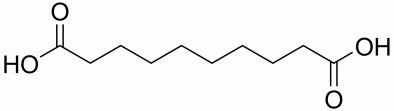
Why it is interesting: Aliphatic polyester polyols used in polyurethane elastomers, are usually based on adipic acid and diols like MEG, DEG, butanediol or mixtures of these. Since recently, succinic acid has become a commercially avaible renewable compound and it makes sense to use it in polyester polyol production. Replacing adipic acid by succinic acid however, results in polyesters with a reduced hydrolysis resistance (at the same polyol molecular weight).  According to this invention this can be solved by using blends of succinic acid with C8 to C36  diacids, most preferably with sebacic (C10) acid.
Not a spectacular innovation and probably not as such patentable but a solid, useful idea.

Sebacic acid

Sebacic acid

  • Pages

  • Categories

  • Enter your email address to follow this blog and receive notifications of new posts by email.

    Join 259 other subscribers
  • Follow Innovation in PU on Twitter